


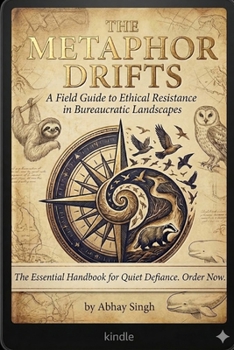
The Metaphor Drifts: A Field Guide to Ethical Resistance in Bureaucratic Landscapes

The Metaphor Drifts reads less like a standard novel and more like a secular liturgy or a field guide for retaining one's soul in an institution. It is a handbook for the ethics of "quiet refusal."
The narrative is built on a rigorous, almost mathematical engine. It rotates through archetypal figures-The Cartographer, The Pilot, The Scribe-placing them in shifting sensory contexts and testing them against recurring conflicts of truth versus belonging.
In every chapter, the protagonist faces a social or political trap. The resolution comes not from human philosophy, but from the "Ethological Pivot" observing the actual adaptive behavior of an animal-the energy conservation of the sloth, the silent glide of the owl, the watchful restraint of the dog-and applying that strategy to a bureaucratic standoff.
This is a masterclass in administrative aikido. It argues that history is often turned not by loud heroism, but by small acts of friction: a misplaced decimal point, a pause before translating a threat, a refusal to seal a document.
Structured as 170 episodic entries, The Metaphor Drifts is essential reading for anyone who works with paperwork, power, or public memory. It reframes "soft" behaviors as "hard" survival strategies in a world demanding conformity.
Customer Reviews
ThriftBooks ® and the ThriftBooks ® logo are registered trademarks of Thrift Books Global, LLC
