


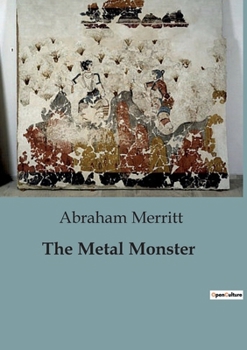
The Metal Monster: A Journey into the Unknown: Mysteries of the Trans-Himalayas
(Book #2 in the Dr. Goodwin Series)


Select Format
Select Condition 
Book Overview
"The Metal Monster" by Abraham Merritt is a captivating tale of adventure and mystery set in the remote and enigmatic regions of the Trans-Himalayas. The story follows Dr. Walter T. Goodwin, a botanist seeking solace from personal grief, as he embarks on a journey through the uncharted territories of Tibet. Accompanied by his newfound companion, Richard Drake, and a Chinese servant, Chiu-Ming, Goodwin encounters a series of inexplicable phenomena that challenge the boundaries of science and reason. The narrative begins with the travelers witnessing a bizarre atmospheric event, where beams of light are seemingly manipulated by an unseen force. As they venture deeper into the mountains, they stumble upon a valley filled with blue poppies and a colossal footprint-like impression, hinting at the presence of an unimaginable power. Their journey leads them to a fortress where they meet Ruth Ventnor and her brother Martin, who recount their own harrowing experiences with ancient Persian-like soldiers and mysterious sounds emanating from a nearby crevice. The group discovers peculiar metallic objects that exhibit a life of their own, transforming and moving with a purpose that defies explanation. These objects, seemingly imbued with intelligence, pose a new enigma for the travelers. As they grapple with the implications of their discoveries, they must also contend with the threat of the ancient soldiers and the unknown forces that govern the region. Merritt's tale is a blend of science fiction and adventure, exploring themes of ancient civilizations, the limits of human understanding, and the intersection of science and the supernatural. The story's rich descriptions and imaginative plot captivate readers, drawing them into a world where the impossible becomes reality.
Format:Paperback
Language:English
ISBN:B0CMZG19JT
ISBN13:9791041824724
Release Date:November 2023
Publisher:Culturea
Length:312 Pages
Weight:0.90 lbs.
Dimensions:0.7" x 5.8" x 8.3"
Customer Reviews
4 ratings
Imaginative concept, not story is the appeal of this classic
Published by Thriftbooks.com User , 17 years ago
The highlight of this book is Merritt's very imaginative concept of a metallic form of life made up of an enormous number of smaller components that can reshape, divide, or combine as needed. Much of this book is spent in an extended exploration/description of this concept. Merritt, writing in 1920, gets very high marks for imagination, anticipating current nanotechnology. This is worth four stars all by itself. The story does not really do justice to the concept, unfortunately. Merritt's dominant female personality, Norhala, doesn't really fit. Merritt seems to include her merely because Merritt is obsessed with such personalities and they feature in most of his books. The scenes against the long lost Persians likewise seems to be grafted on just to give the story some action to offset pages and pages of exposition. The resolution comes right out of nowhere with little foreshadowing. Merritt's descriptions are very poetic - the man had a vocabulary - but ultimately can't be visualized by the reader. This doesn't make the story hard to follow, fortunately, but the reader is pretty much left to his own devices as far seeing the story in his mind's eye. Modern readers will also be put off by the slow pacing that was the fashion when the story was written. Although the book justifies its classic status modern readers would be better starting out with Merritt's "The Ship of Ishtar". Recommended for readers willing to overlook serious flaws. It will reward some patience.
Left An Impression
Published by Thriftbooks.com User , 21 years ago
I read this book in the early seventies while living in Spain. It has left a lasting impression on me and I consider it a lost classic. The plot has been outlined already so I won't get into that, but the metal icky bugs in this story are unique and I've never read anything like it since. After I read this story, I kept noticing a huge sign on a building in Madrid that read, Metal Mazda. I know that has nothing to do with this book, but it always reminded me of Metal Monster and every time we drove into Madrid, there it was! I wish I still had the book somewhere as it warrants a second read. If you want a unique sci-fi story, this is it!
Could make a great movie
Published by Thriftbooks.com User , 25 years ago
When Dr. Walter T. Godwin sets out to study a rare flower in Tibet, he has no idea of what adventures await him. Meeting old friends in the secluded Himalayas, he quickly finds himself fleeing from the descendents of a lost Persian Empire city right into the domain of a seemingly omnipotent metal intelligence. This extraterrestrial metal intelligence is made up of a collective composed of living cubes, pyramids and spheres. Even stranger, the intelligence seems to work through a human woman of great beauty, Norhala. This metal intelligence is beyond anything that Godwin and his compatriots can even understand--is humanity about the be replaced as the ruler of the Earth?OK, this book is a little bit odd at times. He keeps bumping into old friends in the Himalayas, there are descendents of the Persian Empire (a whole city, in fact) that no one knows about, and the ending is something of a deus ex machina. However, for having been written in 1920, this book is quite good! Though the storyline needs a fair amount of suspension of disbelief, it is quite entertaining. Also, when the metal intelligence forms shapes out of its cubes, pyramids and spheres, I couldn't help but think that modern special effects would turn this into quite an excellent movie.So, overall I do recommend this book.
Psychedelia on the Loose
Published by Thriftbooks.com User , 25 years ago
If you happen to be a student in temporal lobe epilepsy here is an example for you. After a "long trek adventure" beginning, this novel lapses into such a prolonged account of person preoccupation with hues of almost unimaginable variety, and forms impossible to imagine or keep track of, that even an enthusiast can barely endure. The male characters (with featureless personalities) and a female (similarly nondescript) float along endlessly on a platform with a hapless donkey. Meanwhile, the riders are surrounded with a blizzard of glows, corpuscles, glimmers, this, that and the other things - until one is left asking like Superman, "What th..?" Merritt does describe rather well a personal projection of his Anima in the novel: Norhalla - too bad she was metallic. Compare Haggard's projection of his Anima, She. As with most popular writing read it for comparison of its short comings with material actually worth reading. I have most of Merrits's other novels. Merritt is interesting as peculiar brain function rather than as a source of literary value.
Copyright © 2026 Thriftbooks.com
Terms of Use | Privacy Policy | Do Not Sell/Share My Personal Information | Cookie Notice | Cookie Preferences | Accessibility Statement
ThriftBooks ® and the ThriftBooks ® logo are registered trademarks of Thrift Books Global, LLC
ThriftBooks ® and the ThriftBooks ® logo are registered trademarks of Thrift Books Global, LLC
