


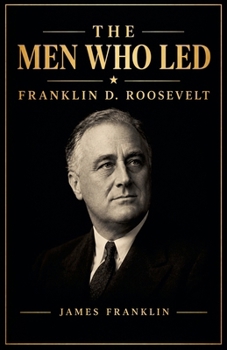
The Men Who Led: Franklin D. Roosevelt

The Men Who Led - Franklin D. Roosevelt
He could not walk across a room yet he carried a nation across its darkest years. This is the story of how.
On the morning of April 12, 1945, Franklin Roosevelt sat in a small house in the Georgia pines, signing papers and holding a pose for a portrait painter, while outside the dogwood bloomed and the war he had managed for three and a half years moved toward its final weeks. At one-fifteen in the afternoon he pressed his fingers to his temple, said he had a terrific headache, and died. He was sixty-three. He had been President of the United States for twelve years, thirty-nine days. He had not finished the portrait. He had not finished much.
This book is the attempt to understand what he did finish, and what it cost him to do it. Franklin Roosevelt inherited a nation in which one in four workers had no job, banks were failing across the country, and the democratic order that the republic had sustained for a century and a half was under pressures that were destroying it elsewhere in the world. He left a nation that had survived the Depression, won the Second World War, built the architecture of the postwar international order, and created a social safety net that redefined the relationship between a government and its people in ways that have proved permanent. He did all of this from a wheelchair, having lost the use of his legs to polio at the age of thirty-nine, and he did it with such thoroughness that the majority of the people who gave him four electoral majorities never fully knew.
Drawing on the full record of Roosevelt's life, the private letters, the medical diaries, the accounts of those inside the White House's innermost circle, this biography examines the complete human being: the only child shaped by a possessive mother and a remote father; the golden young politician whose illness burned away his shallowness and revealed the depths beneath; the husband whose marriage to Eleanor was simultaneously one of the most consequential partnerships in American political history and one of its most painful private arrangements; the president who saved democratic capitalism from itself while making compromises on race that history cannot excuse; the dying man who knew, in the Georgia spring, that the end was close, and who went on working anyway.
Franklin D. Roosevelt is not a portrait of a saint. It is something more interesting and more useful: a portrait of a man who was tested at the absolute limit of what democratic leadership can demand, and who met the test, imperfectly, incompletely, with failures that matter and achievements that endure, and who left the world, when the dogwood bloomed for the last time outside his window, measurably better than he found it.
Customer Reviews
ThriftBooks ® and the ThriftBooks ® logo are registered trademarks of Thrift Books Global, LLC
