


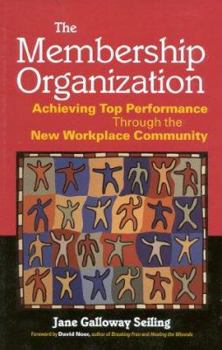
The Membership Organization: Achieving Top Performance Through the New Workplace Community

Provides the vital key to gaining a competitive edge in today's global marketplace. This description may be from another edition of this product.
Format:Hardcover
Language:English
ISBN:089106110X
ISBN13:9780891061106
Release Date:October 1997
Publisher:Davies-Black Publishing
Length:176 Pages
Weight:1.20 lbs.
Dimensions:9.2" x 0.9" x 6.4"
Customer Reviews
1 rating
Seven Principles of Membership
Published by Thriftbooks.com User , 25 years ago
"Working together must indeed become easier." Jane Galloway Seiling writes, "Leaders now know that the effective organization must create an inclusive, more accepting environment, where everyone has respect and dignity. Leaders have decided it is time to open opportunities to deeper participation and involvement by all so that real innovation is possible. But how can this be done? It is increasingly obvious that it is essential to get top performance from people in all areas of circle. A new workplace scenario reflecting a new mind-set- a community of connected people who care more deeply about their organization- is needed" (pp.1-2).Hence, she defines new workplace as 'the new workplace community'. "Community means connections among groups over time. The term evokes images of belonging and pride, a symbolic home. Transferring those images to a 'workplace community'- a workplace that is moral and respectful, and that treats employees as 'responsible agents' of the organization- is highly desirable." According to Jane Galloway Seiling the New Workplace Community: (a). is inclusive, integrative, and flexible, (b). sets goals that attract the input of organizational members, (c). encourages collaborative partnerships, (d). communicates effectively, (e). instills pride in organizational memberships, (f). is steadfast in difficult situations, (g). understands that the phrase 'we are the organization' is significant to the success of the workplace community.In this context, throughout this invaluable book, she discusses the seven principles of membership to the workplace community as follows:1. Contribution: All organizational participants are 'members.' All members, wherever they are in the organizational circle, contribute to the well-being of their co-members and the workplace community. (For detailed discussion see Chapter Two)2. Motivation: Members (1) are competent to perform, (2) are challenged to perform, (3) are personally and collectively empowered to take action, and (4) feel they and their work are significant to the overall achievement of the organization. (For detailed discussion see Chapter Three)3. Decisioning: Decisions are made in the organization through consideration of the three bottom lines: human, social, and financial. The identification of potential long-term outcomes for the organization, as well as for the internal and external customers and the community, are central to the decisioning process. (For detailed discussion see Chapter Four)4. Relationship: For all members, the 'relational approach' is basic in working with others. It is the responsibility of every member to establish connecting relationships that work and that add energy to the individual, the group, and the organization. (For detailed discussion see Chapter Five)5. Leadership: Chosen, assigned leader-members still lead. Leadership happens at all levels, and every member has the potential to be a catalyst for achievement a
Copyright © 2026 Thriftbooks.com Terms of Use
| Privacy Policy | Do Not
Sell/Share My Personal Information | Cookie Policy | Cookie Preferences | Accessibility Statement
ThriftBooks® and the ThriftBooks® logo are registered trademarks of Thrift Books Global, LLC
ThriftBooks® and the ThriftBooks® logo are registered trademarks of Thrift Books Global, LLC
