


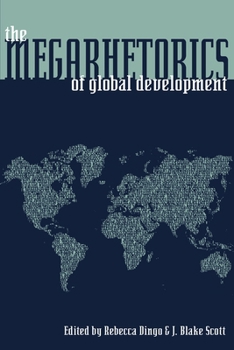
The Megarhetorics of Global Development
No Customer Reviews

After World War II, an unprecedented age of global development began. The formation of the World Bank and the International Monetary Fund allowed war torn and poverty stricken nations to become willing debtors in their desire to entice Western investment and trade. New capital, it was foretold, would pave the way to political and economic stability, and the benefits would \u201ctrickle down\u201d to even the poorest citizens. The hyperbole of this neocolonialism, however, has left many of these countries with nothing but compounded debt and unfulfilled promises. The Megarhetorics of Global Development examines rhetorical strategies used by multinational corporations, NGOs, governments, banks, and others to further their own economic, political, or technological agendas. These wide-ranging case studies employ rhetorical theory, globalization scholarship, and analysis of cultural and historical dynamics to offer in-depth critiques of development practices and their material effects. By deconstructing megarhetorics, at both the local and global level, and following their paths of mobilization and diffusion, the concepts of \u201cprogress\u201d and \u201cgrowth\u201d can be reevaluated, with the end goal of encouraging self-sustaining and ethical outcomes.
Format:Paperback
Language:English
ISBN:0822961725
ISBN13:9780822961727
Release Date:January 2012
Publisher:University of Pittsburgh Press
Length:280 Pages
Weight:0.85 lbs.
Dimensions:0.7" x 5.9" x 9.0"
Customer Reviews
0 rating
Copyright © 2026 Thriftbooks.com
Terms of Use | Privacy Policy | Do Not Sell/Share My Personal Information | Cookie Policy | Cookie Preferences | Accessibility Statement
ThriftBooks ® and the ThriftBooks ® logo are registered trademarks of Thrift Books Global, LLC
ThriftBooks ® and the ThriftBooks ® logo are registered trademarks of Thrift Books Global, LLC
