


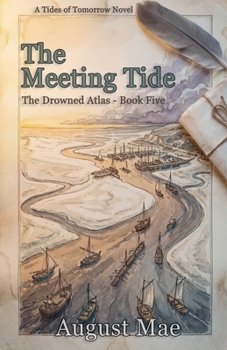
The Meeting Tide

For seven years Wren has read Rhea the way she reads a wake: a passage already going away, the water still troubled by a woman she has missed by a tide, a season, a sheet of killing ice. She has searched five regions and learned the hardest lesson the drowned world has to teach: two people made of motion never meet. You cannot find one person in a severed world. You can only connect the world, community by community, until it hands them back.
Then the spring thaw frees the water, and the Searcher lifts off the strand for the first time since the great freeze. Wren turns her bow not back east towards Wendsey, where Rhea wintered a few miles off, but west and south, because the carried word has named one place and one tide. Every community the Drowned Atlas has knit together is sending its boats to the Severn, to Havenswell, the floating harbour Wren first sailed from alone aboard a boat built for one purpose. It is to be the Meeting Tide: the first great gathering since the Unbinding severed the world fifty years ago.
And Rhea has turned too. Not waiting to be crossed to. Closing the last of the seven years by water, mending pumps and dressing wire the length of the coast, both searchers bound for the same harbour at the same hour, neither chasing the other now. The whole connected world converges on the home water from every road Wren ever opened: the Lagan and their barrage-folk, the Carns up the salt roads, the Knot that is itself a road, the Mere-folk down from the frozen country by the routes the ice taught them to trust, and the Estuary Collective readying an anchorage that has never held more than its own.
The gathering is warm and crowded and difficult, exactly as a true reunion of separated kin is difficult: doubled moorings, rationed water, a hundred honest disagreements between people who have never shared one tide. And in the press of arriving hulls, Wren and Rhea come into the same water at last, close enough to read, with one last small space still uncrossed.
Then the sky turns. A spring storm begins to climb the funnel of the Severn, a deep low driving a surge against the very spring tide the gathering is named for, with more boats in one anchorage than any harbour was built to hold. The reunited world has gathered for the first time in fifty years, and the first thing it must learn is whether it can weather together what would scatter or drown any one of them alone.
A story in the world of the Tides of Tomorrow, and the fifth and final novel of The Drowned Atlas, The Meeting Tide is the convergence the whole series has built towards: hopepunk for readers of Becky Chambers, Emily St. John Mandel, and Lily Brooks-Dalton, warm and storm-skied and built on the conviction that the way to reach one person in a broken world is to mend the whole of it, one community at a time, and then to come to the place it has all agreed to gather, and stay, and ask the question seven years have earned: will the connected world finally hand her back?
Customer Reviews
ThriftBooks ® and the ThriftBooks ® logo are registered trademarks of Thrift Books Global, LLC
