


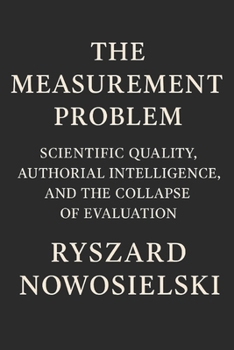
The Measurement Problem: Scientific Quality, Authorial Intelligence, and the Collapse of Evaluation

This book proposes a formal framework for evaluating scientific work by its internal structure rather than external metrics. In response to the collapse of judgment under citation-based systems, The Measurement Problem introduces four computable indicators-Q_total (structural quality), IQ_a (inferred authorial intelligence), UW (unified work value), and O (originality score)-designed to quantify logical coherence, epistemic compression, and conceptual innovation.
The argument is developed across formal, philosophical, and computational dimensions, supported by a logical annex, case-based demonstrations, and precise definitions suitable for both machine parsing and human editorial assessment. Rather than reforming peer review, the book reconstructs scientific evaluation from first principles: thought must be measured by what it builds, not by how it circulates.
This work will interest philosophers of science, metascientists, editors, AI researchers, and institutions seeking post-citation standards of scholarly judgment.
Related Subjects
PhilosophyCustomer Reviews
ThriftBooks ® and the ThriftBooks ® logo are registered trademarks of Thrift Books Global, LLC
