


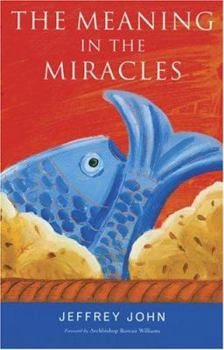
The Meaning in the Miracles

Select Format
Select Condition 
Book Overview
Many explanations of the miracles recorded in the Gospels fall into one of two questionable categories: unthinking acceptance or debunking, which leaves only some vague moral lessons to be learned. In... This description may be from another edition of this product.
Format:Paperback
Language:English
ISBN:0802827942
ISBN13:9780802827944
Release Date:January 2004
Publisher:Eerdmans Pub Co
Length:248 Pages
Weight:0.70 lbs.
Dimensions:8.3" x 0.8" x 5.3"
Customer Reviews
2 ratings
The inner meaning of the miracles
Published by Thriftbooks.com User , 19 years ago
Book Review: The Meaning in the Miracles by Jeffrey John. 2004 (American Edition), Wm. B. Eerdmans & Co., Grand Rapids, Michigan. 248 pp. ISBN 0-8028-2794-2 Recent books, literature, and documentaries in the popular media on early Christianity and the "search for the historical Jesus" signal a fresh look on the part of believing Christians about the origins of their Faith and the meaning of the words and acts of Jesus. This short book, the Meaning in the Miracles by the Reverend Jeffrey John, an Anglican priest and Dean of St. Alban's Cathedral in Hertfordshire, England, represents well this kind of investigation. Reverend John shows how the traditional (i.e., literal) understanding of the miracles of Jesus and the modern (rational or reductionist) explanation for them both miss the point. He uses as the example the well known stories of the feeding of the multitudes by a few loaves and fishes; the traditional understanding is that the gathered throng were physically hungry and Jesus physically and miraculously increased the amount of bread and fish to satisfy them; the reductionist interpretation is that Jesus' teachings convinced the gathered to share unselfishly the food they had brought but hoarded. Reverend John offers a third interpretation, which he calls the inner meaning and which he suggests is the mold by which all the miracles of Jesus should be viewed; that is, that they are theological constructs meant to convey a teaching or portray a truth, often as extended metaphors or allegories. In this sense, his point of view and the majority of the book aligns well with the Baha'i understanding of miracles in general. As Abdu'l-Baha said: "[M]ost of the miracles of the Prophets which are mentioned have an inner significance." (Some Answered Questions, p. 37). Reverend John notes that the feeding of the multitudes miracles are structured to illustrate the elevation of Jesus in the eyes of the Jews to the status of Moses, who gave manna in the desert; and that the food represents the Word of God. We can see a hint of the unity of these two Manifestations of God in this interpretation. In his chapter on the wedding feast of Cana, Reverend John notes how the water signifies the old dispensation and, by inference, the water-turned-to-wine the new dispensation brought by Jesus, a tacit acknowledgement of progressive revelation. Generally, the author observes that his book "investigates [the miracles'] scriptural roots and literary origins, their theological purpose, their religious and social context, and the various levels of meaning they convey." The author quotes from St. Augustine, who apparently held this view and who complained about literal interpretations. He also attempts an exegesis of the meaning of numbers used at different times and places in some of miracle stories, and Baha'is will likely appreciate this type of numerological analysis. The book is well structured. It reviews a series of miracle stories in the
A kernel of truth
Published by Thriftbooks.com User , 20 years ago
This book by Jeffrey John, Dean of St. Alban's Cathedral and one-time candidate for the bishopric in England, is a fairly popular book in Britain - I am surprised it is not better known in the United States. John, experienced as a scholar and a pastor, has the intention of connecting church experience, learning and scholarship to local pastoral situations, and this book serves that purpose well. His introductory chapter highlights 'a tale of two cities' of a sort - the tale of two Religious Education teachers. Mr Davies was a strong, fundamental, literalist reader of the bible: 'had they only appeared in its pages, he would have believed in leprechauns, King Arthur and Father Christmas too.' On the other side was Miss Tomkins, who embraced modern scholarship in its skeptical sense - she tended to see miracles as convergences of natural phenomena, and healing as being done for those largely with psychosomatic illnesses: 'Miss Tomkins loved the word "psychosomatic",' John writes. These are two approaches that may seem diametrically opposed, but John sets forth a case whereby neither of the two really get to the heart of the matter. Beyond the debate of 'how' a miracle occurred, the deeper theological meaning comes from 'why' a miracle occurred, and what meaning is intended to be given to those of us who read the story of the miracle. John cites Augustine as having concern that 'hearers of the Gospel miracles habitually got stuck on the "wonder" element and on speculating whether such a thing could possibly have occurred.' John takes up several elements for discovering the meaning in the miracles - context (particularly that which comes from the Hebrew scriptures), the idea of inclusion of the excluded (a recurring theme in the New Testament message), a challenge for principalities and powers, and the issue of faith. John's book concentrates on gospel miracles - there are many more miracles beyond those which occur in the gospels, both in the Hebrew scriptures and in the New Testament writings outside the gospels. However, it is in the gospel that the most direct connection for Christians takes place. 'All the miracle stories contain profound teaching which is of indispensable relevance to Christians and the Church today, teaching that all too often gets passed over because we do not get past the "miraculous" packaging and the endless issue of "did it happen?" ' John collects many of the miracles - the healing of the leper, the wedding at Cana, the feeding of the thousands, the various blindness and deafness healings, the withered fig tree, and even the resurrections (not Jesus own, but of others). These miracles are presented in chapters which explore context, text variations in the gospels to a small degree, commentaries from others, possible meanings for today's reader, and elements for prayer and meditation that relate to the story. There are eighteen short chapters, each devoted to a single miraculous incident or miraculous type
Copyright © 2026 Thriftbooks.com Terms of Use
| Privacy Policy | Do Not
Sell/Share My Personal Information | Cookie Policy | Cookie Preferences | Accessibility Statement
ThriftBooks® and the ThriftBooks® logo are registered trademarks of Thrift Books Global, LLC
ThriftBooks® and the ThriftBooks® logo are registered trademarks of Thrift Books Global, LLC
