


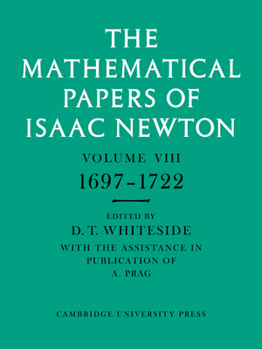
The Mathematical Papers of Isaac Newton: Volume 8
No Customer Reviews

When Newton left Cambridge in April 1696 to take up, at the age of 53, a new career at the London Mint, he did not entirely 'leave off Mathematicks' as he so often publicly declared. This last volume of his mathematical papers presents the extant record of the investigations which for one reason and another he pursued during the last quarter of his life. In January 1697 Newton was tempted to respond to two challenges issued by Johann Bernoulli to the international community of mathematicians, one the celebrated problem of identifying the brachistochrone; both he resolved within the space of an evening, producing an elegant construction of the cycloid which he identified to be the curve of fall in least time. In the autumn of 1703, the appearance of work on 'inverse fluxions' by George Cheyne similarly provoked him to prepare his own ten-year-old treatise De Quadratura Curvarum for publication, and more importantly to write a long introduction to it where he set down what became his best-known statement of the nature and purpose of his fluxional calculus.
Format:Paperback
Language:English
ISBN:0521045916
ISBN13:9780521045919
Release Date:February 2008
Publisher:Cambridge University Press
Length:772 Pages
Weight:2.66 lbs.
Dimensions:1.5" x 6.7" x 9.6"
Related Subjects
Engineering Science Science & Math Science & Scientists Science & Technology TechnologyCustomer Reviews
0 rating
Copyright © 2026 Thriftbooks.com
Terms of Use | Privacy Policy | Do Not Sell/Share My Personal Information | Cookie Notice | Cookie Preferences | Accessibility Statement
ThriftBooks ® and the ThriftBooks ® logo are registered trademarks of Thrift Books Global, LLC
ThriftBooks ® and the ThriftBooks ® logo are registered trademarks of Thrift Books Global, LLC
