


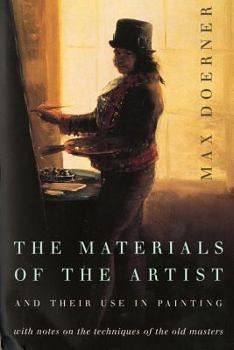
The Materials of the Artist and Their Use in Painting: With Notes on the Techniques of the Old Masters, Revised Edition

Select Format
Select Condition 
Book Overview
The leading authority on the materials and techniques of painting. Index; illustrations. Translated and revised by Eugen Neuhaus.
Format:Paperback
Language:English
ISBN:015657716X
ISBN13:9780156577168
Release Date:January 1984
Publisher:Harper Paperbacks
Length:480 Pages
Weight:1.30 lbs.
Dimensions:1.5" x 5.2" x 8.0"
Customer Reviews
5 ratings
Doerner for art historical approach
Published by Thriftbooks.com User , 18 years ago
Ralph Mayer's classic handbook of art materials has been revised in the fifth edition to include many modern pigments inclusing those of artistic value that come from other industries such as the automotive industry. If you are looking for a comprehensive overview of the materials available to the artist, the Mayer manual is the ideal work. Doerner's treatise, summed up from a series of lectures, is important as a historical work but is not as scientifically in-depth as Mayer's new edition for today's artist or conservationist. Indeed, many claims made by Doerner are not scientifically true just as in Goethe's Theory of Colors (another great book even when compared to the more scientifically accurate "Opticks" by Newton). The veracity of Doerner's approach is in question simply because many of the materials are now outdated, either for their toxicity or for the findings of the scientific community with respect to pigments (i.e. Minium, Vermilion, Naples Yellow, Whie Lead, etc. are now rare finds due to their toxicity). Although I am not necessarily a critic of Doerner, it is important to note that Doerner's importance lies in the realm of evaluative approaches with respect to the techniques of the old masters. If the work of the old masters interests you or if you are an artist, this English translation of Doerner is a worthy addition to your library.
For artists
Published by Thriftbooks.com User , 20 years ago
For the Artist who knows what he or she is at and its certainly not for the hobbiest who would be lost with this book.This for me is a great book as it has enrichened me....information is always good.I am delighted to have it. a worthy addition in any collection.
A great book for serious arists
Published by Thriftbooks.com User , 22 years ago
The language, as inaccurately mentioned in one of the previous reviews, is not that difficult at all. This is not a book for complete beginners, but definitely a must for anyone who considers himself serious as an artist. It provides a very detailed insight into the preparation of materials, the handling of paints and reveals numerous techniques, which were employed by the great masters (not only Renaissance and Baroque, but 18 and 19th century painters and some of the impressionists). There is a separate chapter dedicated entirely to the technique of the old masters. Though, the only drawback I find in this book is that it doesn't spend more time on any of the old masters in particular (it explains their technique quite superficially at times, and only touches the surface when it comes to some of them, so don't expect this book to be about the old masters' technique - it is about technique in general; "the proper way to paint" if you will, with numerous specific examples throughout on how different painters employed this or that method).Overall it is a very good, informative and well-written book, I deeply recommend it!
solid bedrock know-how for the painter
Published by Thriftbooks.com User , 24 years ago
While most curriculums today in art schools will have the words conception underlined, there is a desparate need for the craft of painting to be taught. If you do not want to wait until craftsmanship comes back in style and are a painter, than you must have this book. If you are learning how to better understand the painters of yesterday; you must have this book. If you are curious as to how painters such as Vermeer etc could accomplish want they did, this book is for you. Though the language is sometimes formal the information is so fascinating and inclusive it makes for great and enjoyable reading; Painter or just admirer.
The most important artist manual ever written.
Published by Thriftbooks.com User , 27 years ago
Max Doerner lectured art students with the most accurate information ever compiled up to 1932. About 1900 there was a big change in the manufacturing of color, Max was the artist's protector. "Art has abandoned the sound principles of craftsmanship and is therefore lacking in a dependable foundation". Max Doerner 1931 1916, THEORY, The last color-wheel (square) of college record was by Church-Ostwald. It has Yellow, Red, Sea Green and Ult. Blue at the corners. It made way for the new coal-tar colors, all pigments were replaced by there top-tone matching colors. Naples Yellow, Rubins favorite, and artists favorite for two thousand years, was replaced by a mixture of Zinc and Ocher. Pigments were moving from the Iron Age to the Oil Age. Church-Ostwald had no regard for transparency/opacity, or raw pigment content. Only the final dried color. This is the way todays pigment manufactures make colors. Clearly, the artists interests are not at heart.1886, COLOR, THE FIRST AND LAST PUBLIC STANDARD OF PIGMENT COLORS FOR ARTISTS As noted by Max Doerner. A. W, Keim, German. "Deutche Gesellschatf zur Forderung rationeller Malverfahren", The German Society for the Promotion of Rational Methods in Painting. They set up control for the pigments in colors found best by the artists, to guarantee the color's characteristics and ingredients. These are the colors deemed necessary by the artists; 1.White Lead, 2. Zinc White, 3. Cadmium Yellow Light, Medium and Orange. (Cadmium Red wasn't discovered until 1909), 4. Indian Yellow, 5. Naples Yellow Light and Dark, 6. Yellow to Brown, Natural and Burnt Ochers and Sienna, 7. Red Ocher, 8. Iron Oxide colors, 9. Graphite, 10. Alizarin Crimson, Madder Lake, 11. Vermilion, 12. Umbers, 13. Cobalt Blue, Native and Synthetic, 14. Ultramarine Blue, Natural and Synthetic, 15. Paris-Prussian Blue, 16. Oxide of Chromium, Opaque and Transparent Veridian, 17. Green Earth, 18. Ivory Black, 19. Vine Black. Today we still have no exceptable replacements for the Naples Yellows or Indian Yellow Transparents, Golden or Brown.Turpentine is the best thinner for oil paints. I don't agree with Mayer's Handbook saying that petroleum distilled paint thinner works for fine artwork. Doerner explained in his 1934 book, The Materials of the Artist, how they are unnatural with paints that absorb oxygen while drying. Being refined from a nondrying petroleum oil, they only evaporate, without absorbing oxygen. Petroleum thinners are good only for cleaning brushes of the trade, not the expensive brushes we use as artists. Petroleum thinner will not dissolve the valuable damar varnish either, as turpentine does so well. You can see now why this book was suppressed after the wars. It was not in the paint manufactures best interest to let this knowledge get back to the new emerging artists.If you are a serious artist, I urge you to get this book, The Materials of the Artist by Doerner. Compare it to the Mayer's Artists Handbook and see how just inf
Copyright © 2026 Thriftbooks.com Terms of Use
| Privacy Policy | Do Not
Sell/Share My Personal Information | Cookie Policy | Cookie Preferences | Accessibility Statement
ThriftBooks® and the ThriftBooks® logo are registered trademarks of Thrift Books Global, LLC
ThriftBooks® and the ThriftBooks® logo are registered trademarks of Thrift Books Global, LLC
