


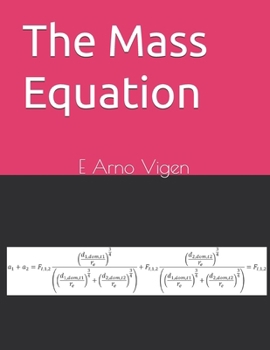
The Mass Equation: My Breakthrough Position-in-Field Approach from Hemispherical (r,θ,φ, z=X0=±1/2)
No Customer Reviews

What is mass? Fixed or variable . . . Virtual particles . . . for remote planets or for subatomic particles?
Mass is hidden in every equation from Newton's Third Law of Motion a=F/m. But, today approach is a complete 'particle zoo' to refine predictions and it gets solid predictions using different combinations and constants for different chemistry and physics events.
I take a new approach to show that mass flows for physical particles, grouped at various knowable distances, relative to an equilibrium. That produces a specific case for the fine structure constant.
More importantly, that provides an equation for mass to improve every current equation.
- Mass is based upon (d/a0) (4/3)
- Mass is based upon a max at particle edge versus Bohr-H sixth power, (re/a0) 6.
- Mass for remote objects is radial electrostatic (rES) for the central protons versus the electron shells at 8/7a0. So, gravity is always rES divided by the average 4/3PI(8/7a0) 3.
- Mass for elementary particles is combinations of physical particles based upon (8/7)(1/2) (1/3) modifying the Rydberg (N) (1/3) in current methods.
- However, that needs a further adjustment because Shell-1 is only ones level while others are double-sets (2, 8, 8, 18, 18, 32, 32) as minus (1/2) (1/6).
- Thereby, the gravity constants (G) is Planck's constant cube root. (G/(3/2)*2 3)=(h/(3/2)*2 3) (1/3)
With that, every use of mass gets replaced as directly related to h, c, re, and a0.
Mass is hidden in every equation from Newton's Third Law of Motion a=F/m. But, today approach is a complete 'particle zoo' to refine predictions and it gets solid predictions using different combinations and constants for different chemistry and physics events.
I take a new approach to show that mass flows for physical particles, grouped at various knowable distances, relative to an equilibrium. That produces a specific case for the fine structure constant.
More importantly, that provides an equation for mass to improve every current equation.
- Mass is based upon (d/a0) (4/3)
- Mass is based upon a max at particle edge versus Bohr-H sixth power, (re/a0) 6.
- Mass for remote objects is radial electrostatic (rES) for the central protons versus the electron shells at 8/7a0. So, gravity is always rES divided by the average 4/3PI(8/7a0) 3.
- Mass for elementary particles is combinations of physical particles based upon (8/7)(1/2) (1/3) modifying the Rydberg (N) (1/3) in current methods.
- However, that needs a further adjustment because Shell-1 is only ones level while others are double-sets (2, 8, 8, 18, 18, 32, 32) as minus (1/2) (1/6).
- Thereby, the gravity constants (G) is Planck's constant cube root. (G/(3/2)*2 3)=(h/(3/2)*2 3) (1/3)
With that, every use of mass gets replaced as directly related to h, c, re, and a0.
Format:Paperback
Language:English
ISBN:B0BYM1CDXL
ISBN13:9798385849772
Release Date:March 2023
Publisher:Independently Published
Length:260 Pages
Weight:1.34 lbs.
Dimensions:0.6" x 8.5" x 11.0"
Customer Reviews
0 rating
Copyright © 2026 Thriftbooks.com Terms of Use
| Privacy Policy | Do Not
Sell/Share My Personal Information | Cookie Policy | Cookie Preferences | Accessibility Statement
ThriftBooks® and the ThriftBooks® logo are registered trademarks of Thrift Books Global, LLC
ThriftBooks® and the ThriftBooks® logo are registered trademarks of Thrift Books Global, LLC
