


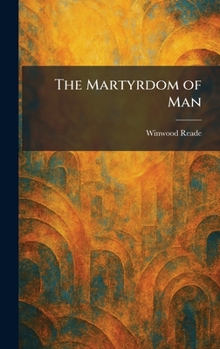
The Martyrdom of Man

"The Martyrdom of Man" is a sweeping work of universal history and secular philosophy that seeks to map the trajectory of human civilization through four distinct phases: War, Religion, Liberty, and Intellect. Winwood Reade presents a provocative narrative that reframes the struggle of humanity not as a series of divine interventions, but as a grueling evolutionary process where progress is born from collective suffering.
The text explores the rise and fall of ancient empires-from the Egyptians and Persians to the Greeks and Romans-while tracing the development of major world religions and their impact on social structures. Reade argues that the "martyrdom" of individuals throughout history has served as the necessary price for the advancement of the species, ultimately leading toward a future governed by reason and scientific understanding.
Highly influential in the late Victorian era and cited by figures such as H.G. Wells and Winston Churchill, "The Martyrdom of Man" remains a foundational text for rationalist and humanist thought. It offers a profound meditation on the resilience of the human spirit and the relentless pursuit of knowledge in a world stripped of supernatural explanations. This work continues to be valued for its bold historical synthesis and its eloquent defense of secular progress.
This work has been selected by scholars as being culturally important, and is part of the knowledge base of civilization as we know it. This work was reproduced from the original artifact, and remains as true to the original work as possible. Therefore, you may see the original copyright references, library stamps (as most of these works have been housed in our most important libraries around the world), and other notations in the work.
This work is in the public domain in the United States of America, and possibly other nations. Within the United States, you may freely copy and distribute this work, as no entity (individual or corporate) has a copyright on the body of the work.
As a reproduction of a historical artifact, this work may contain missing or blurred pages, poor pictures, errant marks, etc. Scholars believe, and we concur, that this work is important enough to be preserved, reproduced, and made generally available to the public. We appreciate your support of the preservation process, and thank you for being an important part of keeping this knowledge alive and relevant.
Customer Reviews
ThriftBooks ® and the ThriftBooks ® logo are registered trademarks of Thrift Books Global, LLC
