




Select Format
Select Condition 
Book Overview
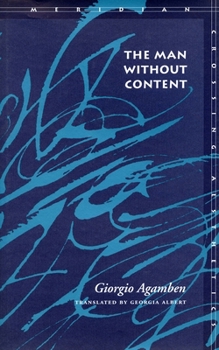
In this book, one of Italy's most important and original contemporary philosophers considers the status of art in the modern era. He probes the meaning and historical consequences of the indefinite continuation of art in what Hegel called a "self-annulling" mode, in the process offering an imaginative reinterpretation of the history of aesthetics from Kant to Heidegger.
Format:Paperback
Language:English
ISBN:0804735549
ISBN13:9780804735544
Release Date:June 1999
Publisher:Stanford University Press
Length:144 Pages
Weight:0.45 lbs.
Dimensions:0.5" x 5.4" x 8.4"
Customer Reviews
2 ratings
Genial but a bit too German
Published by Thriftbooks.com User , 24 years ago
This is the first book by Agamben I have read, and it's quite an impressive encounter. Agamben has a lively historical imagination, and seems comfortable in tracing the manner in which art and the aesthetic has shifted in status and situation from the middle ages to the 20th century. When Agamben is using his native Italian intelligence, he's first-rate. However, when the names Hegel or Heidegger are invoked, the discussion tends to become arid, vaporous, and unnecessarily enamoured of Greek etymons. Frankly, I wish Agamben had never read either of the H's - too much teutonic fog dims even his Latin acuity.
Agamben's "aesthetics"
Published by Thriftbooks.com User , 25 years ago
Giorgio Agamben is quite simply one of the most profound living philosophers and essayists, and this is one of his most illuminating texts. In it, Agamben takes up the question of the status of the work of art in capitalist culture. Much of his critique draws upon Heidegger's later essays on the relationship between technology and art ("The Question Concerning Technology", "What are Poets For?"), attempting to explore the implications of Heidegger's concern that art may have already become "standing reserve." However, this book owes as much to Hannah Arendt's _The Human Condition_, especially her reading of the history of political theory through her trichotomy of labor, work, and action. Throughout his book, however, Agamben takes these ideas in startling new directions, always seeking out new connections between concepts and pushing them to their limits. He also writes in a reasonably clear style, avoiding much of the word-play of contemporary continental philosophy, although it probably won't be very accessible to readers without some understanding of recent continental philosophy. All in all, this might be the most significant contribution to the philosophy of art since Adorno's _Aesthetic Theory_.
Copyright © 2026 Thriftbooks.com Terms of Use
| Privacy Policy | Do Not
Sell/Share My Personal Information | Cookie Policy | Cookie Preferences | Accessibility Statement
ThriftBooks® and the ThriftBooks® logo are registered trademarks of Thrift Books Global, LLC
ThriftBooks® and the ThriftBooks® logo are registered trademarks of Thrift Books Global, LLC
