


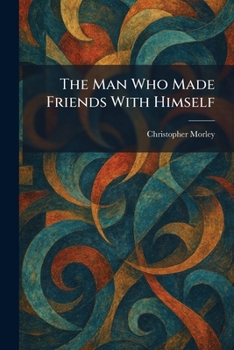
The Man Who Made Friends With Himself

Select Format
Select Condition 
Book Overview
"The Man Who Made Friends With Himself" is a deeply introspective and whimsical novel that explores the complexities of the human psyche through the life of Richard Tolman, a literary agent living in a quiet suburban setting. The narrative delves into Tolman's internal world as he grapples with the presence of a mysterious doppelg nger-a figure who represents his own hidden thoughts, anxieties, and aspirations. Through this unique psychological lens, Christopher Morley crafts a story that is both a witty social commentary and a profound meditation on self-identity.
Written with Morley's signature charm and erudition, the work captures the essence of a mid-century intellectual seeking meaning in the mundane. The protagonist's journey is one of self-discovery, filled with literary allusions, philosophical musings, and a touch of the surreal. As Tolman navigates his professional responsibilities and personal relationships, his ongoing dialogue with his other self serves as a poignant reminder of the multifaceted nature of the individual. "The Man Who Made Friends With Himself" remains a significant contribution to psychological fiction, offering readers a clever and heartfelt examination of the friends and foes we find within our own minds.
This work has been selected by scholars as being culturally important, and is part of the knowledge base of civilization as we know it. This work was reproduced from the original artifact, and remains as true to the original work as possible. Therefore, you may see the original copyright references, library stamps (as most of these works have been housed in our most important libraries around the world), and other notations in the work.
This work is in the public domain in the United States of America, and possibly other nations. Within the United States, you may freely copy and distribute this work, as no entity (individual or corporate) has a copyright on the body of the work.
As a reproduction of a historical artifact, this work may contain missing or blurred pages, poor pictures, errant marks, etc. Scholars believe, and we concur, that this work is important enough to be preserved, reproduced, and made generally available to the public. We appreciate your support of the preservation process, and thank you for being an important part of keeping this knowledge alive and relevant.
Customer Reviews
ThriftBooks ® and the ThriftBooks ® logo are registered trademarks of Thrift Books Global, LLC
