


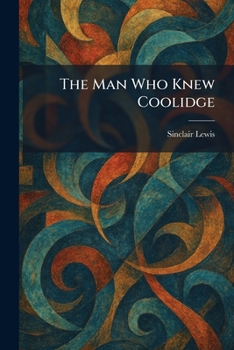
The Man Who Knew Coolidge

Select Format
Select Condition 
Book Overview
"The Man Who Knew Coolidge" is a sharp-witted satirical novel by Nobel Prize winner Sinclair Lewis. Composed as a series of monologues, the work features Lowell Schmaltz, a middle-class office supply salesman from the fictional city of Zenith who exemplifies the "Babbittry" Lewis famously critiqued in his earlier works. Schmaltz is a man of endless opinions and limited insight, whose primary claim to fame-his supposed friendship with President Calvin Coolidge-serves as the centerpiece for his rambling, often hilarious observations on American society, politics, and the virtues of the "Standard Citizen."
Through Schmaltz's voice, Lewis provides an incisive look at the conformism and commercialism of the 1920s. The narrative captures the specific cadence of the era's boosterism and the superficiality of social climbing. As a companion piece to "Babbitt", this work offers a masterclass in character-driven satire, exposing the anxieties and vanities of the American Everyman during the Jazz Age. Readers will find in Schmaltz a protagonist who is at once ridiculous and profoundly reflective of the cultural pressures of his time. This volume remains a vital piece of American literary history, showcasing Lewis's unmatched ability to mirror the speech and spirit of his contemporaries while delivering a timeless critique of status-seeking behavior.
This work has been selected by scholars as being culturally important, and is part of the knowledge base of civilization as we know it. This work was reproduced from the original artifact, and remains as true to the original work as possible. Therefore, you may see the original copyright references, library stamps (as most of these works have been housed in our most important libraries around the world), and other notations in the work.
This work is in the public domain in the United States of America, and possibly other nations. Within the United States, you may freely copy and distribute this work, as no entity (individual or corporate) has a copyright on the body of the work.
As a reproduction of a historical artifact, this work may contain missing or blurred pages, poor pictures, errant marks, etc. Scholars believe, and we concur, that this work is important enough to be preserved, reproduced, and made generally available to the public. We appreciate your support of the preservation process, and thank you for being an important part of keeping this knowledge alive and relevant.
Customer Reviews
ThriftBooks ® and the ThriftBooks ® logo are registered trademarks of Thrift Books Global, LLC
