


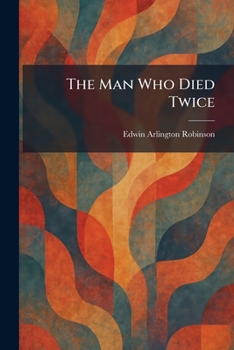
The Man Who Died Twice

Select Format
Select Condition 
Book Overview
Winner of the Pulitzer Prize for Poetry, "The Man Who Died Twice" is a profound narrative work by acclaimed American poet Edwin Arlington Robinson. The poem explores the tragic yet transformative journey of Fernando Nash, a musician of extraordinary potential who abandons his creative gifts for a life of self-destruction and dissipation. Robinson masterfully depicts the psychological weight of wasted genius, as Nash experiences a metaphorical death of his spirit and artistic ambition long before his physical passing.
Through poignant verse, Robinson examines themes of redemption and the enduring power of the human soul. After hitting the depths of despair, the protagonist finds a quiet, spiritual resolution that offers a stark contrast to his earlier failures. This work is celebrated for its deep psychological insight and its rhythmic, evocative language, cementing Robinson's reputation as a master of the narrative form. "The Man Who Died Twice" remains a powerful meditation on the nature of art, the consequences of choice, and the possibility of finding peace after a lifetime of regret.
This work has been selected by scholars as being culturally important, and is part of the knowledge base of civilization as we know it. This work was reproduced from the original artifact, and remains as true to the original work as possible. Therefore, you may see the original copyright references, library stamps (as most of these works have been housed in our most important libraries around the world), and other notations in the work.
This work is in the public domain in the United States of America, and possibly other nations. Within the United States, you may freely copy and distribute this work, as no entity (individual or corporate) has a copyright on the body of the work.
As a reproduction of a historical artifact, this work may contain missing or blurred pages, poor pictures, errant marks, etc. Scholars believe, and we concur, that this work is important enough to be preserved, reproduced, and made generally available to the public. We appreciate your support of the preservation process, and thank you for being an important part of keeping this knowledge alive and relevant.
Related Subjects
PoetryCustomer Reviews
ThriftBooks ® and the ThriftBooks ® logo are registered trademarks of Thrift Books Global, LLC
