


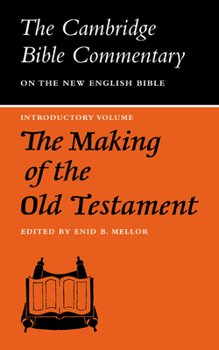
The Making of the Old Testament


Select Format
Select Condition 
Book Overview
The Making of the Old Testament is one of three books accompanying the volumes of commentary in the Old Testament and Apocrypha series of Cambridge Bible Commentaries on the New English Bible. This volume is concerned with the formation of the books of the Old Testament and Apocrypha in the context of the ancient Near Eastern World, and with the ways in which these books have come down to us through the Jewish and Christian communities. Individual chapters discuss other literary documents contemporary with events in the Old Testament; the style of and critical approaches to the Old Testament books; other Jewish writing (Apocrypha and pseudepigrapha); the development of the Old Testament canon; the development of the modern English text from the various earlier versions; and the place of the Old Testament in modern Judaism and Christianity. Each of the chapters is followed by suggestions for further reading.
Format:Paperback
Language:English
ISBN:0521096731
ISBN13:9780521096737
Release Date:June 1972
Publisher:Cambridge University Press
Length:228 Pages
Weight:0.58 lbs.
Dimensions:0.5" x 5.0" x 8.0"
Customer Reviews
1 rating
An Amazing Journey into the History of The Old Testament
Published by Thriftbooks.com User , 18 years ago
Prologue: In an attempt to write a concise but clear review of this cornerstone book, and to help appreciate the long and complicated evolution of the Hebrew Bible, considered a pre-requisite to conceive the Good News of the New Testament, the great Biblical scholars of the Church of Alexandria, with Origen at the head of its Catechetical Didaskaleon included the OT writings as integral part of the Orthodox Christian readings. Origen is the greatest scholar of the Hebrew Bible, ever, and the first to discover few of the Dead Sea scrolls. In checking and correcting the Septuagint Koine translations, which began at Alexandrine in the third century B.C., and continued to its completion by learned Jewish Rabbis, he wrote his voluminous study, the Hexapla in 22 years. When I was ten years old I heard in Alexandria about the leaders of the Christian school, and was fascinated with Origen, and my interest in the O.T. never ceased since. The Oral tradition: In the last decade, after a confirmation visit to the Oriental Institute, university of Chicago, I got the confirmation on the roots of the Hebrew language, and its development. The oral transmission played a main role in the way the bible was formed and interpreted. I here quote, Julio Barrera, "In the initial stages, the living word of narrators and prophets became a written text. In the closing stages, the written word began to be interpreted, first orally, and then using material from the oral tradition." The Torah which may have started with Moses, writing Genesis, which echoes the Heliopolitan Cosmology, ex Chaos. there has been no Hebrew written language then, and new discoveries point to its creation out of Heratic Egyptian, as ProtoSinaitic, to ProtoCanaanite, the mother language of Aramaic, Canaanite, Hebrew, and Arabic. By about 1100 BC, the North Semitic alphabet had settled down into a form known as Phoenician, because it was used by the Phoenicians, the great Semitic traders who lived in the land to the east of the Mediterranean, todays Lebanon. The Phoenician alphabet could have evolved from the more natural sytle of Proto-Sinaitic into a more linear form during about the 12th century BC. Most of the alphabets known today are descended from Phoenician. The immediate offspring of Phoenician were the old Hebrew alphabet, and Aramaic, as well as Archaic Greek. The Hebrew alphabet was also used by Moabites as well as Israelites. This alphabet, though, eventually disappeared from the mainstream, surviving as the Samaritan script, while Aramaic became extremely popular, and many Lavant people adopted it, at the time of Jesus. Old Testament collection: The Old Testament is a collection of certain sacred writings, composed and edited by the Hebrew/Jewish scribes, between the twelfth century B.C. and the fourth century B.C. Those includes such diverse materials as commandments, instructions for priests, prophetic oracles, teachings of wise men, and ancient records of the Judaic royal courts.
Copyright © 2026 Thriftbooks.com
Terms of Use | Privacy Policy | Do Not Sell/Share My Personal Information | Cookie Notice | Cookie Preferences | Accessibility Statement
ThriftBooks ® and the ThriftBooks ® logo are registered trademarks of Thrift Books Global, LLC
ThriftBooks ® and the ThriftBooks ® logo are registered trademarks of Thrift Books Global, LLC
