


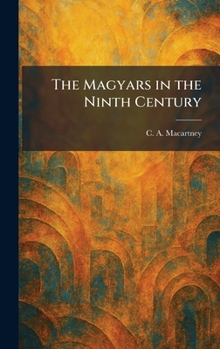
The Magyars in the Ninth Century

"The Magyars in the Ninth Century" is a rigorous scholarly examination of the origins, migrations, and early history of the Hungarian people during a formative era. Author C.A. Macartney provides a detailed reconstruction of the Magyars' movements from the Pontic-Caspian steppes to the Carpathian Basin, focusing on the century preceding their permanent settlement in Central Europe.
The work delves into the intricate social and political structures of the Magyar tribes, analyzing their interactions with contemporary powers such as the Khazar Khaganate, the Byzantine Empire, and various Slavic populations. By critically evaluating diverse primary sources-ranging from Byzantine administrative texts and Arabic geographical treatises to early medieval chronicles-Macartney offers a comprehensive view of the ethnic identity and military strategies that defined these nomadic groups. This study remains a significant contribution to the field of medieval history, offering deep insights into the demographic and geopolitical shifts that paved the way for the establishment of the Hungarian state. It is an essential resource for those interested in medieval ethnogenesis, nomadic history, and the historical development of Eastern and Central Europe.
This work has been selected by scholars as being culturally important, and is part of the knowledge base of civilization as we know it. This work was reproduced from the original artifact, and remains as true to the original work as possible. Therefore, you may see the original copyright references, library stamps (as most of these works have been housed in our most important libraries around the world), and other notations in the work.
This work is in the public domain in the United States of America, and possibly other nations. Within the United States, you may freely copy and distribute this work, as no entity (individual or corporate) has a copyright on the body of the work.
As a reproduction of a historical artifact, this work may contain missing or blurred pages, poor pictures, errant marks, etc. Scholars believe, and we concur, that this work is important enough to be preserved, reproduced, and made generally available to the public. We appreciate your support of the preservation process, and thank you for being an important part of keeping this knowledge alive and relevant.
Related Subjects
HistoryCustomer Reviews
ThriftBooks ® and the ThriftBooks ® logo are registered trademarks of Thrift Books Global, LLC
