


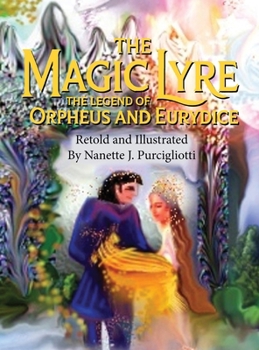
The Magic Lyre, The Legend of Orpheus and Eurydice

The legend of Orpheus and Eurydice is one of the most famous and tragic of all Greek myths. After researching the myriad versions of this myth, retold and explored in various forms by filmmakers, musicians, and artists, the author decided to craft her own rendition. Her primary source was "Metamorphoses, Book X." As the story goes, when Orpheus's bride, Eurydice, with her fragile beauty, disappears on the day of their wedding, Orpheus strums his six-stringed lyre, and sings melancholy songs, sensing the magic of his music will lead him to her. And off he goes, journeying over green fields, over sheer mountains, into fiery chasms. The magic of his music leads him over the River Styx, into the land of the dead. There he meets mythical creatures along the way. But it isn't until he encounters the broad-shouldered King of Hades, that another journey begins. He is told his bride is under the care of Queen Persephone. He begs for his wife's freedom, and using his skills as the most famous musician in the world, he strives to set his bride free. Unlike the original ending where Orpheus and Eurydice's souls reunite in the afterlife, Nanette wrote her own surprise ending. The timeless tale is complemented by her painterly illustrations.
Customer Reviews
ThriftBooks ® and the ThriftBooks ® logo are registered trademarks of Thrift Books Global, LLC
