


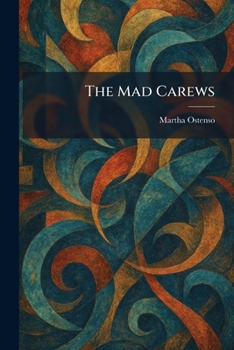
The Mad Carews

Select Format
Select Condition 
Book Overview
"The Mad Carews" is a powerful exploration of family legacy and the weight of tradition set against the stark backdrop of the American prairie. The story centers on the influential Carew family, whose men are notorious for their impulsive, often reckless behavior-a trait the local community has come to call the 'Carew madness.' When Elsa Bowers, a strong-willed woman from a humbler background, marries into the clan, she finds herself navigating a complex web of pride, secrets, and the volatile temperaments of the men she now calls kin.
Martha Ostenso, a master of regional realism, masterfully depicts the tension between individual desires and the inherited expectations of a storied name. Through Elsa's eyes, the reader witnesses the struggle to maintain one's identity within a family defined by its eccentricities and scandals. "The Mad Carews" is a compelling drama of love and endurance, capturing the rugged spirit of the rural Midwest and the psychological depths of those bound to its soil. This work remains a significant example of early 20th-century literature, highlighting the social hierarchies and emotional landscapes of a developing frontier society.
This work has been selected by scholars as being culturally important, and is part of the knowledge base of civilization as we know it. This work was reproduced from the original artifact, and remains as true to the original work as possible. Therefore, you may see the original copyright references, library stamps (as most of these works have been housed in our most important libraries around the world), and other notations in the work.
This work is in the public domain in the United States of America, and possibly other nations. Within the United States, you may freely copy and distribute this work, as no entity (individual or corporate) has a copyright on the body of the work.
As a reproduction of a historical artifact, this work may contain missing or blurred pages, poor pictures, errant marks, etc. Scholars believe, and we concur, that this work is important enough to be preserved, reproduced, and made generally available to the public. We appreciate your support of the preservation process, and thank you for being an important part of keeping this knowledge alive and relevant.
Customer Reviews
ThriftBooks ® and the ThriftBooks ® logo are registered trademarks of Thrift Books Global, LLC
