


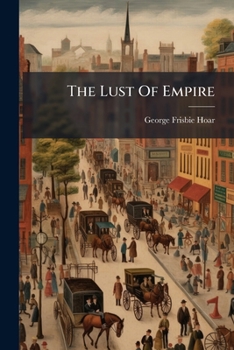
The Lust Of Empire: Speech Of Hon. George F. Hoar Of Massachusetts In The United States Senate, April 17, 1900

Select Format
Select Condition 
Book Overview
"The Lust Of Empire" presents the powerful speech delivered by Senator George F. Hoar of Massachusetts on April 17, 1900, before the United States Senate. In this address, Hoar passionately critiques the burgeoning American imperialism following the Spanish-American War and the subsequent conflict in the Philippines. With eloquence and moral conviction, Hoar argues against the acquisition of foreign territories and the subjugation of their peoples, asserting that such actions contradict the fundamental principles of American democracy and self-governance.
This speech offers valuable insights into the political and ethical debates surrounding America's role in the world at the turn of the 20th century. Hoar's words resonate even today, inviting reflection on the enduring tensions between national ambition and moral responsibility. "The Lust Of Empire" is a compelling historical document that captures a pivotal moment in American history, showcasing the courage and vision of a senator who dared to challenge the prevailing winds of expansionism.
This work has been selected by scholars as being culturally important, and is part of the knowledge base of civilization as we know it. This work was reproduced from the original artifact, and remains as true to the original work as possible. Therefore, you will see the original copyright references, library stamps (as most of these works have been housed in our most important libraries around the world), and other notations in the work.
This work is in the public domain in the United States of America, and possibly other nations. Within the United States, you may freely copy and distribute this work, as no entity (individual or corporate) has a copyright on the body of the work.
As a reproduction of a historical artifact, this work may contain missing or blurred pages, poor pictures, errant marks, etc. Scholars believe, and we concur, that this work is important enough to be preserved, reproduced, and made generally available to the public. We appreciate your support of the preservation process, and thank you for being an important part of keeping this knowledge alive and relevant.
Customer Reviews
ThriftBooks® and the ThriftBooks® logo are registered trademarks of Thrift Books Global, LLC
