


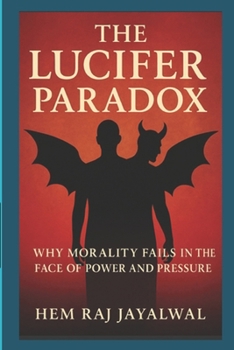
The Lucifer Paradox: Why Morality Fails in the Face of Power and Pressure
No Customer Reviews

THE LUCIFER PARADOX:
In The Lucifer Paradox, Hem Raj Jayalwal undertakes a profound psychological and philosophical investigation into one of the most troubling questions of human behaviour: Why do good people sometimes do bad things? What makes morality collapse under pressure, and how do ordinary individuals become perpetrators or bystanders in systems of injustice?
Rooted in the symbolic tale of Lucifer-the fallen angel who was once a bearer of light-the book explores the paradoxical transformation of human nature when influenced by power, pressure, fear, and social conformity. Drawing on psychological research, such as the Stanford Prison Experiment and Milgram's obedience studies, Jayalwal highlights the vulnerability of the human conscience in the face of situational forces.
The book is structured in twelve in-depth chapters, each tackling a unique facet of this transformation: Understanding the Lucifer Paradox examines the symbolic fall of Lucifer and parallels it with real-life psychological studies that reveal how good people can turn toward evil when circumstances align against their better judgement.When Virtue Meets Authority explains how obedience to figures of authority can override individual morality, leading people to commit or justify harmful actions-even when they internally disagree.The Power Trap focuses on how the possession of power often distorts empathy and rationalizes cruelty. Through case studies of institutions, leadership, and historic events, it illustrates the seduction and corrupting influence of power.Pressure and the Collapse of Conscience analyses how peer pressure, social conformity, and fear of isolation lead to inaction and moral paralysis, even among people who consider themselves ethically strong.Masks of Morality exposes the tools people use to morally disengage, such as euphemistic language, denial of responsibility, and the dehumanisation of victims.The Institutional Web looks at how systems-educational, religious, governmental, and corporate-can enable moral decay through indoctrination, control, and structural complicity.Breaking the Cycle offers tools for awareness and resistance. Jayalwal emphasises the importance of critical thinking, ethical education, and the empowerment of moral dissenters.Rebuilding Ethical Strength discusses how to cultivate enduring values such as compassion, courage, and integrity in personal and public life, ensuring that morality becomes resilient rather than fragile.The Role of Media and Technology explores how digital platforms amplify both moral awakening and moral collapse, affecting public perception, echo chambers, and the spread of misinformation.Children of the System studies how societal structures shape young minds and how early education can be a critical tool in fostering future generations who are ethically grounded and resistant to unjust pressures.Cults, Charisma, and Control delves into the dark allure of charismatic leaders, cult mentalities, and rigid belief systems that erode individual moral judgement and autonomy.Everyday Heroism concludes with a hopeful message: that within every person lies the potential not only for cruelty but also for courage. The final chapter encourages readers to embrace their own capacity for moral action, even in the face of systemic odds.The book ends with a powerful conclusion titled "Choosing the Light," which affirms that understanding our moral vulnerabilities is the first step in transforming them into strengths. Through this lens, The Lucifer Paradox becomes not only an examination of darkness but a guide toward integrity, resilience, and redemption.
With its compelling blend of science, storytelling, and social critique,
In The Lucifer Paradox, Hem Raj Jayalwal undertakes a profound psychological and philosophical investigation into one of the most troubling questions of human behaviour: Why do good people sometimes do bad things? What makes morality collapse under pressure, and how do ordinary individuals become perpetrators or bystanders in systems of injustice?
Rooted in the symbolic tale of Lucifer-the fallen angel who was once a bearer of light-the book explores the paradoxical transformation of human nature when influenced by power, pressure, fear, and social conformity. Drawing on psychological research, such as the Stanford Prison Experiment and Milgram's obedience studies, Jayalwal highlights the vulnerability of the human conscience in the face of situational forces.
The book is structured in twelve in-depth chapters, each tackling a unique facet of this transformation: Understanding the Lucifer Paradox examines the symbolic fall of Lucifer and parallels it with real-life psychological studies that reveal how good people can turn toward evil when circumstances align against their better judgement.When Virtue Meets Authority explains how obedience to figures of authority can override individual morality, leading people to commit or justify harmful actions-even when they internally disagree.The Power Trap focuses on how the possession of power often distorts empathy and rationalizes cruelty. Through case studies of institutions, leadership, and historic events, it illustrates the seduction and corrupting influence of power.Pressure and the Collapse of Conscience analyses how peer pressure, social conformity, and fear of isolation lead to inaction and moral paralysis, even among people who consider themselves ethically strong.Masks of Morality exposes the tools people use to morally disengage, such as euphemistic language, denial of responsibility, and the dehumanisation of victims.The Institutional Web looks at how systems-educational, religious, governmental, and corporate-can enable moral decay through indoctrination, control, and structural complicity.Breaking the Cycle offers tools for awareness and resistance. Jayalwal emphasises the importance of critical thinking, ethical education, and the empowerment of moral dissenters.Rebuilding Ethical Strength discusses how to cultivate enduring values such as compassion, courage, and integrity in personal and public life, ensuring that morality becomes resilient rather than fragile.The Role of Media and Technology explores how digital platforms amplify both moral awakening and moral collapse, affecting public perception, echo chambers, and the spread of misinformation.Children of the System studies how societal structures shape young minds and how early education can be a critical tool in fostering future generations who are ethically grounded and resistant to unjust pressures.Cults, Charisma, and Control delves into the dark allure of charismatic leaders, cult mentalities, and rigid belief systems that erode individual moral judgement and autonomy.Everyday Heroism concludes with a hopeful message: that within every person lies the potential not only for cruelty but also for courage. The final chapter encourages readers to embrace their own capacity for moral action, even in the face of systemic odds.The book ends with a powerful conclusion titled "Choosing the Light," which affirms that understanding our moral vulnerabilities is the first step in transforming them into strengths. Through this lens, The Lucifer Paradox becomes not only an examination of darkness but a guide toward integrity, resilience, and redemption.
With its compelling blend of science, storytelling, and social critique,
Format:Paperback
Language:English
ISBN:B0FJXK157G
ISBN13:9798293725281
Release Date:July 2025
Publisher:Independently Published
Length:136 Pages
Weight:0.42 lbs.
Dimensions:0.3" x 6.0" x 9.0"
Customer Reviews
0 rating
Copyright © 2025 Thriftbooks.com
Terms of Use | Privacy Policy | Do Not Sell/Share My Personal Information | Cookie Policy | Cookie Preferences | Accessibility Statement
ThriftBooks ® and the ThriftBooks ® logo are registered trademarks of Thrift Books Global, LLC
ThriftBooks ® and the ThriftBooks ® logo are registered trademarks of Thrift Books Global, LLC
