


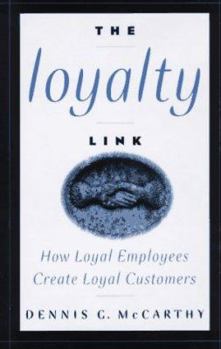
The Loyalty Link: How Loyal Employees Create Loyal Customers


Select Format
Select Condition 
Book Overview
The answer to keeping your customers is simple, keep your employees happy Forget everything you2ve ever heard about cusomter service. The key to retaining customers isn2t making your customers happy, but ensuring that your employees are. In fact, for all the talk of customer service and the shelves of books on the topic, most companies lose half of their customers every five years. According to Dennis McCarthy, these companies get it wrong because they fail to make the link between employee loyalty and customer loyalty. With wit, insight, and real-world examples, he illustrates how to increase employee loyalty to ensure a trusting and loyal customer base as well as to improve profitability, competitiveness, and market share. One of the first books to address a pervasive and puzzling problem confronting the modern day workplace McCarthy has been a keynote speaker on this subject at industry conferences and client-sponsored events for companies such as GMAC, Forbes, NYNEX, and Inc. Magazine DENNIS McCARTHY (Fairfield, Connecticut) is President and CEO of the Paradigm Group, a management, sales, and customer service consulting firm with clients such as General Electric, GE Capital, Honeywell, and Southern New England Telephone.
Format:Hardcover
Language:English
ISBN:0471163899
ISBN13:9780471163893
Release Date:April 1997
Publisher:WILEY
Length:198 Pages
Weight:1.00 lbs.
Dimensions:8.8" x 0.8" x 5.8"
Customer Reviews
2 ratings
Don't underestimate the role played by loyal employees
Published by Thriftbooks.com User , 19 years ago
This is one of the few books I've seen that attempts to link the important role employees play in delivering an experience that builds customer loyalty. Well known author and loyalty champion Fred Reichheld's early work; The Loyalty Effect, certainly laid the platform that employee, customer and shareholder loyalty are all key ingredients to success, but most authors, include Reichheld himself, have tended to focus on Customer Loyalty as the key driver. So this book looks at a much under-discussed aspect of loyalty. Like many business publications today, the real high interest content is found in the first half of the book. In these 100 or so pages, Dennis McCarthy presents a well prepared case for building customer loyalty. His argument draws from many proponents of the topic and he supplements this with good additional data looked at from a new perspective. All good stuff! His description of `expectation gaps and the intended customer experience' was one of those `ah ha' moments for me, which has instant application value. The book just paid for itself right then and there! I liked the themes around customer loyalty, the Loyalty Deficit Cycle and the commitment needed to deliver on the promise. And I liked the way the argument built to support the importance of having loyal employees to realize this objective. From then on though, the book goes on to look at ways to engage employees through approaches such as Employee Empowerment, Flexi time and Work-Life Balance. But it really didn't established how treating employees as they would like to be treated, builds loyalty. I get the idea, but I didn't see the causal relationship that leads to employee loyalty and how one would measure it. The book left me wanting more. Perhaps it was meant to?
Simple, values based and totally practical
Published by Thriftbooks.com User , 27 years ago
Far too much resource is spent on building "whizz-bang" customer loyalty programmes that forget the basic premise - customer loyalty is built on the company culture. The Loyalty Link reminds us that customers deal with individual employees and those individuals must provide or exceed the service the customers expect if the company wants to retain them. Those same individuals will only ever provide or exceed that service level if they feel appreciated, supported, and well rewarded. McCarthy challenges the idea of companies who strive for customer satisfaction, stating that there is a wide gap between a "satisfied" customer and a "loyal" customer - one who will spend more with the company, refer others onto the company, cost you far less to service and be more tolerant when you do make a mistake. The Loyalty Link reinforces some management "concepts" (find what really motivates employees, empowering employees, self-managed team etc) which are not new, and takes a bold step further to say there is a real correlation between customer loyalty and employee loyalty and it is totally manageable. A book I would recommend for all levels of management.
Copyright © 2026 Thriftbooks.com Terms of Use
| Privacy Policy | Do Not
Sell/Share My Personal Information | Cookie Policy | Cookie Preferences | Accessibility Statement
ThriftBooks® and the ThriftBooks® logo are registered trademarks of Thrift Books Global, LLC
ThriftBooks® and the ThriftBooks® logo are registered trademarks of Thrift Books Global, LLC
