


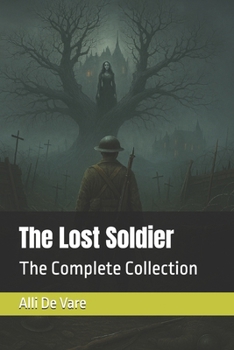
The Lost Soldier: The Complete Collection

The Great War did not just break men. It broke time.
Elias Vance returned from the Ypres Salient with a wooden leg, a mind carved hollow by survivor guilt, and an impossible memory. For twenty years, while the world marched onward into a fragile peace, Elias remained stuck in the pulling, monstrous mud of 1914. He remembers the shells, the gas, and the metallic tang of swallowed blood. Yet he also remembers a grand French manor house standing entirely untouched in the middle of No Man's Land. It was a place where the clocks had stopped, where the rooms smelled of lavender, and where a girl named lise de Chastenet stood at the window, waiting for a sun that never rose.
For two decades, the asylums called him mad. They told him the house was a phantom born of shell shock.
Then lise begins to appear in his waking hours, her fingers leaving damp, muddy prints on his jacket.
Driven by a debt he cannot name, Elias returns to the scarred fields of Flanders. Guided by old trench logs, unmapped village whispers, and the blood-soaked soil itself, he hunts for the vanished estate. What he finds inside that temporal wound is not a sanctuary, but a horror. It is a family bound by a desperate, ancestral pact, a house that stays beautiful by feeding on the raw trauma of the dead, and a terrifying mechanism known as the Anguish Engine.
But pulling lise out of the dark is only the first mistake.
Their escape shatters a delicate equilibrium, awakening powers that have spent centuries waiting in the shadows of the European continent. From the hidden tunnels of a secret railway to the forgotten vaults of drowned libraries, Elias and lise find themselves hunted by men who do not merely want to record history; they want to weaponize it.
Every act of mercy in this broken landscape demands payment. Every step forward forces the earth to recount its prehistoric tally. Surrounded by occult scholars, secretive weavers, and lethal, forbidden artifacts, Elias must decide what a single life is worth when saving the girl he loves might tear the twentieth century completely open at the seams.
Turn the page, but listen closely to the silence between the notes. The past is not dead. It is simply waiting in the mud for the rain to fall again.
Customer Reviews
ThriftBooks ® and the ThriftBooks ® logo are registered trademarks of Thrift Books Global, LLC
