


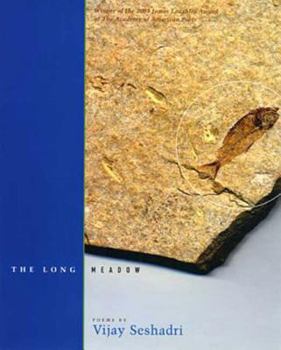
The Long Meadow

Select Format
Select Condition 
Book Overview
Now in paperback, The Long Meadow, the highly praised second collection by Vijay Seshadri, winner of the 2003 James Laughlin Award from the Academy of American Poets We hold it against you that you... This description may be from another edition of this product.
Format:Hardcover
Language:English
ISBN:1555974007
ISBN13:9781555974008
Release Date:May 2004
Publisher:Graywolf Press
Length:58 Pages
Weight:0.50 lbs.
Dimensions:0.5" x 7.4" x 9.1"
Customer Reviews
2 ratings
Wish I Had Written This
Published by Thriftbooks.com User , 21 years ago
I was delighted by this book! And it seems clear to me that Seshadri delighted in writing it. His range and sense of play -- his capacity for wit and irony on the one-hand (particularly in the longer, fairytale inspired poems), and exquisite tenderness on the other (in the shorter lyrics) -- kept me fully engaged the whole way through. Especially rewarding were the poems where Seshadri dared to write out of more personal material-- about his son, fatherhood, married love. In these, he delivers a one-two punch, bringing to bear his unfailing attention to craft and a willingness to explore emotional territory that is at once grounded in the daily and rife with mythic overtones. I go back again and again to these poems. Here is a poet who has reached a magnificent stride, and we are all the beneficiaries.
Universality in the Particular
Published by Thriftbooks.com User , 21 years ago
Vijay Seshadri's The Long Meadow is to be enjoyed and admired on many levels: the poems manage to tap into a universal that can be held only in the finely specific; there is a sense of timelessness joined to a burning present; and a highly developed sense of irony which often acts as a kind of veiled entrance into the deeply sensitive. Sometimes, it is only after reading Vijay Seshadri's poems a couple of times that the form becomes apparent, so subtle and fine is his ear. And after the form emerges, the meaning only deepens. When I think of the relationship between form and meaning, a beautiful poem of his called "Anima" comes to mind, in which he imagines his lost "other", and himself as "her quizzical, her other,/ her bitter, prodigal, absconded half./ Where, just where, am I that I can never come back?". In Vijay Seshadri's poems, form and meaning act, in a way, as though they were two such entities that he often, it feels, quite miraculously unites. I think of the rather heartbreaking poem, "Aphasia", which also appeared in a recent New Yorker. The form so subtly mirrors the disease: the rhymed couplets are contained by the unrhymed first and last lines of the stanzas, as though the brain were losing its order from the outside in, or, that the order could no longer be released from the already disintegrating surface where brain meets outer world, human being communicates with human being. AphasiaHis signs flick off.His names of birdsand his beautiful words -eleemosynary, fir, cinerarium, reckless -skip like pearls from a snapped necklacescattering over linoleum.His thinking won'tventure out of his mouth.His grammar heads south.Pathetic his subjunctives; just as pathetichis mangling the emphatic enclitiche was once the master of.Still, all in all, he hashis inner weather of pure meaning,though the wind is keeningthrough his Alps and his clouds hang lowand the forecast is "Rain mixed with snow,heavy at times." There is too, the stunning love poem, "The Painted Things": "One hour isn't enough for the bangle on your wrist,/ one day for your jewel-encrusted breastplate./ One night dies/ expecting your velvet garter. ... because I have eyes slow enough for you,/ I have eyes to wait for you". There is a Whitmanesque embracing of humankind in many of the poems. I note only "A Fable". There is a story about a boy, the boy's future wife, the boy's father, and a donkey. The poem talks about all humans having come from this one boy; in essence, that we all "though diverse and ignorant / of one another, though pressed like grapes / through the bewildering human genotypes" have something in common. There are too the father and son writings, both with poet as son and poet as father, which have both a powerful specificity and a deeply moving universality and humanity. And of course, "The Disappearances", the poem which so many found healing to read in the New Yorker just after the tragedy of 9/11.
Copyright © 2026 Thriftbooks.com Terms of Use
| Privacy Policy | Do Not
Sell/Share My Personal Information | Cookie Policy | Cookie Preferences | Accessibility Statement
ThriftBooks® and the ThriftBooks® logo are registered trademarks of Thrift Books Global, LLC
ThriftBooks® and the ThriftBooks® logo are registered trademarks of Thrift Books Global, LLC
