


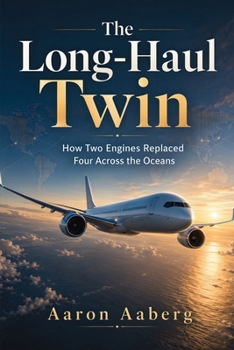
The Long-Haul Twin: How Two Engines Replaced Four Across the Oceans

For much of the jet age, the great ocean routes belonged to aircraft with three or four engines. The Boeing 707, Douglas DC-8, Boeing 747, McDonnell Douglas DC-10, Lockheed L-1011, Airbus A340, and Airbus A380 all reflected an era when long-distance confidence was closely tied to visible engine redundancy. Crossing the Atlantic, the Pacific, the Indian Ocean, or remote polar regions demanded aircraft that could satisfy the safety rules, engineering limits, and airline economics of their time.
The Long-Haul Twin tells the factual story of how that world changed. Through the rise of ETOPS, improved turbofan reliability, stronger aircraft systems, better maintenance monitoring, and relentless pressure to reduce fuel burn, two-engine wide-body aircraft gradually took over routes once associated with trijets and four-engine giants. The Boeing 767 opened the door, the Boeing 777 changed the scale, the Airbus A330 proved the versatility of the twin-engine wide-body, and later aircraft such as the Boeing 787 and Airbus A350 carried the revolution into a new generation of long-range efficiency.
This book follows the transformation from the era of the jumbo jet to the modern long-haul twin, explaining how regulations, engines, route planning, airline balance sheets, passenger cabins, cargo economics, and network strategy all worked together to reshape global aviation. It is a story of aircraft design, commercial pressure, safety discipline, and the quiet normalisation of two engines across the oceans.
Disclaimer
This is an independent, unofficial work of aviation history and analysis. It is not authorised, sponsored, endorsed, or approved by Boeing, Airbus, McDonnell Douglas, Lockheed, Rolls-Royce, General Electric, Pratt & Whitney, the Federal Aviation Administration, the International Civil Aviation Organization, any airline, manufacturer, regulator, airport authority, or other entity mentioned in the text. All company names, aircraft model names, airline names, regulatory terms, and trademarks are used only for factual, historical, descriptive, and nominative purposes. All trademarks remain the property of their respective owners.
Related Subjects
TransportationCustomer Reviews
ThriftBooks ® and the ThriftBooks ® logo are registered trademarks of Thrift Books Global, LLC
