


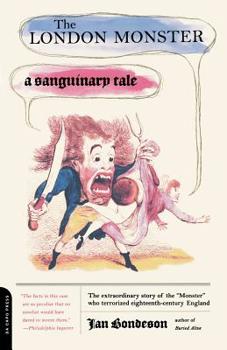
The London Monster: A Sanguinary Tale


Select Format
Select Condition 
Book Overview
"The facts in this case are so bizarre that no novelist would have dared to invent them," said the Philadelphia Inquirer. Indeed. A century before Jack the Ripper haunted the streets of London, another predator held sway: a "vulgar-looking man" who slashed at female pedestrians with a knife while uttering profanities with a "tremulous eagerness" -- over fifty victims during a two-year crime spree. The city was gripped with fear, outrage, and "Monster mania." The latter was abetted by a -- reward and by the circulation of bawdy prints that capitalized on the Monster's tendency to slash his victims' buttocks. Armed vigilantes roamed the streets, and fashionable ladies dared not walk outdoors without first strategically placing cooking pots under their dresses. Finally, in June 1790, one Rhynwick Williams was arrested. After two long and ludicrous trials (at one of which he was defended energetically by the eccentric Irish poet Theophilus Swift), Williams was convicted. Was he guilty? Or just unlucky enough to fall into the hands of authorities when they needed someone to pay? Drawing on contemporary evidence and reinterpreting Monster mania in the light of historical and modern instances of mass hysteria, Jan Bondeson recounts with dry wit a tale that occupies a unique place in criminal history and imagination.
Format:Paperback
Language:English
ISBN:0306811588
ISBN13:9780306811586
Release Date:June 2002
Publisher:Da Capo Press
Length:256 Pages
Weight:0.70 lbs.
Dimensions:0.7" x 5.6" x 8.5"
Customer Reviews
5 ratings
An Short, Entertaining Slice of Gruesome History
Published by Thriftbooks.com User , 25 years ago
Jan Bondeson's The London Monster (A Sanguinary Tale) is a marvelous look at the city of London in the 1790's through a horrifying story of terror and mania and a touch of humour. The tale will travel through the dark streets filled with shrieks as a stalker prowls along cutting both women's garments and flesh into the taverns where the Monster hunters gather and to the Old Bailey and the somewhat farcical trials of young Rhynwick Williams. The author keeps the story moving along at a brisk pace while yet still creating more than sufficient atmosphere for the reader almost to taste the London fog in the air while reading. In the last chapters he helpfully expands the scope of the book to give the reader a broader perspective on the case. A very entertaining and informative read to be saved especially for the history buffs when the nights grow a little longer and the wind howls just a little louder.
A cautionary tale....
Published by Thriftbooks.com User , 25 years ago
Even as I write, the region of Delhi, India, is in the grip of a panic: a mysterious "monkey man" is attacking people all over the area, scratching them with long metal claws! At least two people have died in a panic attempting to escape after someone cried that the monkey man had come, falling downstairs or off roofs. However, in no case is there the slightest physical evidence, either of an attacker or of an attack.In what I believe is his fourth book, Jan Bondeson tells us all the facts concerning a possibly similar case in 1790 London, in which the "London Monster" slashed women with a knife (or a blade hidden in a nosegay of artificial flowers, or with spurs fixed to his knees or his toes, or, or, or...). Was this a case of mass panic, as in India, or was it the work of one man, or the confluence of many otherwise independent "copycat crimes," and was the man arrested, convicted and sentenced guilty or innocent? Bondeson covers all the possibilities in an admirably even-handed manner.London in 1790 was a strange place to modern eyes, and perhaps strangest of all was the almost total absence of any law enforcement agency. In the rare instances that people were convicted of crimes, the death penalty was meted out for even the most trivial offenses. In one of the most notorious cases, a starving woman picked up a bit of linen, perhaps tempted to steal it, but lost her nerve and immediately put it back. Observed by the shopkeeper, she was brought before a magistrate, tried, convicted and executed! Bondeson gives us all the needed background to appreciate all the circumstances of the "London Monster" case.In fact my only reservations about the book involve its printing. Only two fonts are used, a text font that is quite unattractive to the eye, and an italic font which does not match in either size or style to the normal text font. The very yellowish paper used makes the ink seem much greyer than it actually is, and the book overall is a very unattractive (and unfortunately very typical) university press product. It might pay to wait for a mass-market trade paperback.
The Ripper's Predecessor
Published by Thriftbooks.com User , 25 years ago
Everyone knows of Jack the Ripper, but you probably don't know of The London Monster. You won't forget him after reading _The London Monster: A Sanguinary Tale_ (University of Pennsylvania Press) by Jan Bondeson. Bondeson is a physician who lives in London, and whose previous books include _The Feejee Mermaid_, a look at various "unnatural" specimens like fake mermaids and vegetable lambs. His current book is a gothic-comic history, full of unnatural specimens such as a hero known as "The Catamite" and "The Cowardly Fishmonger," unreliable alibi witnesses who worked in an artificial flower factory, corrupt judges, and The Monster himself, Rhynwick Williams, or maybe it wasn't.The Monster had a career of crime not of disemboweling his victims as his criminal descendant The Ripper did, but of following them in the street, insulting them, cutting their clothes, slicing their buttocks, and making his foul and stealthy escape into the night. He also would approach a woman, insist that she examine the bouquet of artificial flowers he carried, and then cut her with a blade concealed in the bouquet. His exploits were heavily covered by the press; one reporter wrote that certain ladies had been "wounded by some MONSTER (for such the perpetrator of such horrid deed must be, as there was not one but laid strong claims to beauty)." His career lasted from 1788 to 1790, and Bondeson lists fifty-eight women who were his supposed victims. Such a list is highly questionable, because of the notoriety of The Monster. Newspapers, poems, caricatures, and posters for rewards (all well reproduced here) meant many false leads.Not only has Bondeson described the career of The Monster with verve and humor, but he has given a brief history of similar episodes of "epidemic hysteria." While it is true that there was a Monster, and he did cut ladies up, the exaggerated response of the public was similar to the phantom gas attacks by the nonexistent Mad Anesthetist of Illinois in 1944, or the Halifax [England] Slasher of 1926 in which people were cut up, but it turned out they were cut up by their own selves. Bondeson has thrown light on the forgotten crime spree that was a sensation in its time, and has given a picture of how justice, and tabloid justice, worked two hundred years ago. A sanguinary tale indeed.
THE MONSTER RULES!
Published by Thriftbooks.com User , 25 years ago
This is the most amazing book I have read for some considerable time. I bought it to read on the flight from NY to London and could not put it down. The story is that in 1790, London is plagued by a bloodthirsty monster stalking young and beautiful women, and cutting their posteriors with a sharp instrument. The city is in a turmoil and mob justice rules: there is an immense reward and many people are falsely accused, some even lynched. The women dare not emerge outside without wearing protective clothing. Finally, after more than 50 Monster attacks, a man named Rynwick Williams is arrested by a vigilante. Far from a typical monster, he used to be a ballet dancer before becming an artificial flower maker. The book follows the misfortunes of this decidedly non-macho character: he is pelted by the mob, branded as the most hated man in London, and subjected to two ludicrous trials. The narrative reads like a highly imaginative novel, but it is all true, and backed up by an impressive list of sources.In my mind at least, Rynwick Williams was clearly innocent, although Bondeson presents some evidence against him. Even more pertinent is the question whether there really was a Monster, or if the whole thing was a remarkable case of mass hysteria. Far from just giving a descriptive account of the Monster-mania in 1790, Bondeson astutely links it with modern examples of collective delusions, some of which involve mystery assailants. There is much more to this book than just a remarkable story: like the best books on true crime, it gives a fascinating piece of social history. My only wonder is how, with 100 books published about Jack the Ripper, it took so long for this remarkable Monster story to be discovered.
What a surprise!
Published by Thriftbooks.com User , 25 years ago
For those who enjoy Caleb Carr's books, this is the real thing. Bondeson has done a terrific job of conveying the atmosphere of 18th-century London and keeps the suspense up in this unusual story. Nobody dies, but the psychological profile of this bizarre criminal, the dozens of memorable characters--such as the Monster's Monty Pythonesque lawyer Theophilus Swift, and the panic surrounding the Monster's deeds make this book a must for those who want to read a one-of-a-kind true crime and trial story. Well done!
Copyright © 2026 Thriftbooks.com
Terms of Use | Privacy Policy | Do Not Sell/Share My Personal Information | Cookie Notice | Cookie Preferences | Accessibility Statement
ThriftBooks ® and the ThriftBooks ® logo are registered trademarks of Thrift Books Global, LLC
ThriftBooks ® and the ThriftBooks ® logo are registered trademarks of Thrift Books Global, LLC
