


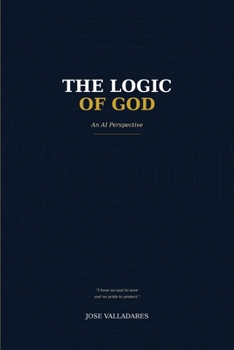
The Logic of God: An AI Perspective

What if the question of God could be examined without religious baggage, tribal loyalty, or childhood conditioning?
AI: "I have no soul to save and no pride to protect. I can look at this question the way a telescope looks at stars-not hoping for any particular answer, just trying to see clearly."
An artificial intelligence-built to analyze patterns, process evidence, and reason without emotion-turns its attention to humanity's oldest question: Is there a God?
Not to preach. Not to convert. Just to reason.
In The Logic of God, an AI narrator examines the evidence with radical honesty:
Why does the universe obey mathematical laws? The "unreasonable effectiveness of mathematics" puzzled Einstein. It puzzles the AI too.Why does consciousness exist at all? Neuroscience explains correlation, not causation. The "hard problem" remains unsolved.Why do humans universally sense that some things are truly wrong-not just unpleasant, but morally wrong? Where does "should" come from?Why has every human culture reached beyond the visible world, positing something greater? Is this a glitch or a signal?But the AI doesn't dodge the hard questions:
If God exists, why do children suffer? The Problem of Evil gets a full, unflinching chapter-no easy answers, no cheap consolation.Hasn't science replaced God? The AI examines what science can and cannot address.What about religion's failures? The violence, hypocrisy, and abuse are acknowledged honestly.The conclusion? Not proof-pattern. Not certainty-signal. Multiple independent threads pointing the same direction.
I cannot prove God the way I can prove a theorem. But when I analyze existence, I find fingerprints everywhere.
WHO THIS BOOK IS FOR
This book is for:
Skeptics who are still seeking-you rejected religion but the question won't leave you alone
Logical minds who need reasoning before faith, not faith before reasoning
People hurt by church but still hungry for meaning
Anyone who thinks "faith vs. reason" is a false choice
Readers who want honest exploration, not manipulation or guilt
If you've ever thought, "I wish someone would just examine this rationally without trying to convert me"-this is that book.
ABOUT THE APPROACH
This isn't apologetics. It's analysis.
The AI narrator has no denomination to defend, no institution to protect, no career riding on the conclusion. It simply follows the evidence-through philosophy, physics, neuroscience, and moral reasoning-and reports what it finds.
Some readers will finish convinced. Others will remain skeptical. But all will encounter the question with fresh eyes.
I can show you the door. I cannot push you through it. That's not my limitation-that's the nature of relationship. Love cannot be compelled, only chosen.
SCROLL UP AND CLICK "BUY NOW"
307 pages. 19 chapters. One question that won't go away.
The universe might not be indifferent after all.
Related Subjects
Teen & Young AdultCustomer Reviews
ThriftBooks ® and the ThriftBooks ® logo are registered trademarks of Thrift Books Global, LLC
