


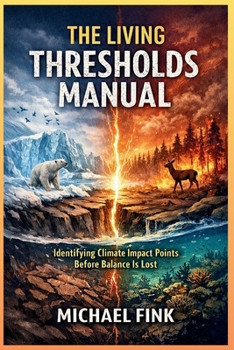
The Living Thresholds Manual: Identifying Climate Impact Points Before Balance Is Lost

Climate change rarely happens gradually.
It unfolds through thresholds.
Across Earth's most important systems-forests, oceans, polar ice, and atmospheric circulation-there are critical tipping points where stability suddenly gives way to rapid transformation. Once these thresholds are crossed, recovery becomes difficult, costly, or impossible.
The Living Thresholds Manual reveals how these invisible boundaries shape the future of our planet.
Written as a clear and practical guide, this book explains how scientists identify climate tipping points, recognize early warning signals, and interpret the subtle patterns that appear before environmental balance is lost.
Instead of focusing only on distant projections, this manual concentrates on the decisive moments where change begins-the impact points where natural systems shift from resilience to instability.
Inside this powerful climate science guide, you will discover:
How climate tipping points form in Earth systems
The early signals that indicate a system is approaching collapse
Why ecosystems often appear stable until a sudden shift occurs
The science behind planetary boundaries and system resilience
Key global tipping risks, including ice sheets, forests, and ocean currents
How early detection of climate impact points can support better policy and environmental decisions
Combining environmental science, systems thinking, and climate research, The Living Thresholds Manual provides readers with a deeper understanding of the fragile equilibrium that sustains life on Earth.
This book is ideal for readers interested in:
Climate science
Environmental systems
Ecosystem resilience
Climate tipping points
Planetary boundaries
Earth system dynamics
Environmental policy and risk
If you want to understand where the most important climate changes actually begin, this guide will show you the signals.
Because the future of the planet will not be decided slowly.
It will be decided at the thresholds.
Buy this book today and learn how to recognize the climate signals that appear before balance is lost.
Customer Reviews
ThriftBooks ® and the ThriftBooks ® logo are registered trademarks of Thrift Books Global, LLC
