


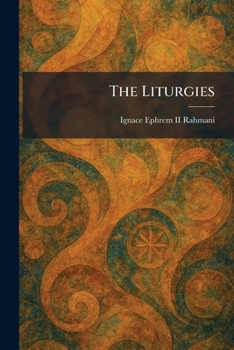
The Liturgies

"The Liturgies" is a profound scholarly and devotional compilation that explores the rich liturgical heritage of the Syrian tradition. Curated by Ignace Ephrem II Rahmani, the Syrian Patriarch of Antioch and a distinguished scholar of Eastern Christianity, this work serves as an essential bridge to the ancient worship practices of the Syriac-speaking world. The text provides a detailed examination of the sacramental rites and prayers that have defined the spiritual life of the Antiochene church for centuries.
Within these pages, readers will find a meticulous presentation of liturgical texts that reflect the theological depth and poetic beauty of the Eastern Rite. Rahmani's expertise ensures that the collection is not only a tool for worship but also a significant historical document for theologians and historians of religion. "The Liturgies" captures the essence of a living tradition, offering insights into the evolution of Christian ritual and the enduring legacy of the Syrian Church. This volume is an invaluable resource for anyone seeking to understand the foundations of Christian liturgy or the specific nuances of the Syrian traditions. It stands as a testament to the intellectual and spiritual labor of one of the early 20th century's most important Eastern prelates.
This work has been selected by scholars as being culturally important, and is part of the knowledge base of civilization as we know it. This work was reproduced from the original artifact, and remains as true to the original work as possible. Therefore, you may see the original copyright references, library stamps (as most of these works have been housed in our most important libraries around the world), and other notations in the work.
This work is in the public domain in the United States of America, and possibly other nations. Within the United States, you may freely copy and distribute this work, as no entity (individual or corporate) has a copyright on the body of the work.
As a reproduction of a historical artifact, this work may contain missing or blurred pages, poor pictures, errant marks, etc. Scholars believe, and we concur, that this work is important enough to be preserved, reproduced, and made generally available to the public. We appreciate your support of the preservation process, and thank you for being an important part of keeping this knowledge alive and relevant.
Customer Reviews
ThriftBooks ® and the ThriftBooks ® logo are registered trademarks of Thrift Books Global, LLC
