


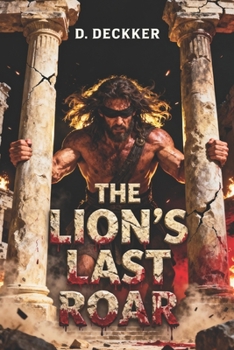
The Lion's Last Roar: A Biblical fiction

Before he was born, a stranger stood in a field and told his mother what he would be. Nobody asked him.
Samson of Zorah grows up with seven braids no razor may touch, in a hill village that pays a fifth of its harvest to the Philistines every year. He cannot eat a grape. He cannot go near the dead. And sometimes, without warning, a heat climbs the back of his neck, and his hands do things no man's hands can do. Afterward he cannot hold a cup.
He never chose the vow. He never chose the strength. At eighteen he walks down to the Philistine town of Timnah and sees a woman arguing with a potter over a cracked jug, and for the first time in his life he chooses something.
What follows is the story Judges tells in ninety-six verses: a lion in a vineyard, honey taken from its carcass, a wedding riddle that costs thirty men their lives, three hundred foxes and a valley on fire. Three thousand of his own people come to hand him over in ropes. He spends twenty years judging other men's quarrels over oxen. Then a weaver in the valley of Sorek asks him the one question nobody has ever asked, and keeps asking.
The Lion's Last Roar stays close to the biblical account and fills only its silences. It asks what it was like to carry a gift that came and went as it pleased, and to be the son of a mother who was told he would begin to save Israel and was never told how. It follows him to a slave's grindstone in Gaza, blind, with his hair growing back, and to the last prayer of a man who had prayed only once before.
Customer Reviews
ThriftBooks ® and the ThriftBooks ® logo are registered trademarks of Thrift Books Global, LLC
