


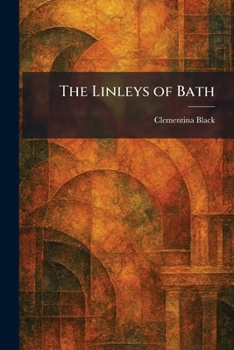
The Linleys of Bath

Select Format
Select Condition 
Book Overview
"The Linleys of Bath" offers a captivating and detailed portrait of one of the most talented and celebrated musical families of 18th-century England. Written by Clementina Black, this biographical work delves into the lives of the Linley family, whose members were renowned for their extraordinary musical gifts and their presence in the social and cultural heart of Bath. At the center of the narrative are the beautiful and gifted Linley sisters, most notably Elizabeth Ann, whose voice charmed the nation and whose elopement with the playwright Richard Brinsley Sheridan became one of the great romantic scandals of the era.
Black meticulously chronicles the family's rise to prominence, their artistic triumphs, and the personal joys and tragedies that defined their lives. The book provides an intimate glimpse into the vibrant social scene of Georgian England, where music, theater, and high society intersected. Beyond mere biography, "The Linleys of Bath" serves as a historical document that preserves the legacy of a family that profoundly influenced the English musical tradition. It is an essential read for those interested in music history, the Georgian period, and the enduring allure of 18th-century social life.
This work has been selected by scholars as being culturally important, and is part of the knowledge base of civilization as we know it. This work was reproduced from the original artifact, and remains as true to the original work as possible. Therefore, you may see the original copyright references, library stamps (as most of these works have been housed in our most important libraries around the world), and other notations in the work.
This work is in the public domain in the United States of America, and possibly other nations. Within the United States, you may freely copy and distribute this work, as no entity (individual or corporate) has a copyright on the body of the work.
As a reproduction of a historical artifact, this work may contain missing or blurred pages, poor pictures, errant marks, etc. Scholars believe, and we concur, that this work is important enough to be preserved, reproduced, and made generally available to the public. We appreciate your support of the preservation process, and thank you for being an important part of keeping this knowledge alive and relevant.
Customer Reviews
ThriftBooks ® and the ThriftBooks ® logo are registered trademarks of Thrift Books Global, LLC
