


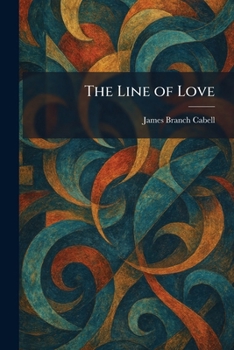
The Line of Love

"The Line of Love" is an evocative collection of stories that explore the complexities of romance, lineage, and chivalry through the lens of James Branch Cabell's distinct literary vision. Set against backdrops ranging from medieval France to old England, these tales serve as a genealogical exploration of the human heart, tracing the romantic fortunes of several generations across the centuries. Cabell utilizes his signature blend of irony and ornate prose to depict the ideals of courtly love and the often-humorous reality of their pursuit.
Throughout the volume, readers encounter a series of star-crossed lovers and gallant figures whose lives are defined by their passions and the codes of honor that govern their societies. Each narrative within "The Line of Love" contributes to the broader mythological tapestry Cabell created, offering a sophisticated look at the recurring patterns of desire and duty. The work remains a significant example of early 20th-century romanticism and historical fantasy, showcasing the author's ability to blend rich atmosphere with timeless psychological insight.
Whether navigating the politics of a royal court or the intimate dynamics of a private tryst, the characters in "The Line of Love" are portrayed with a depth that transcends mere archetype. This collection is essential reading for those interested in the evolution of romantic literature and the meticulously crafted worlds of one of America's most unique literary voices.
This work has been selected by scholars as being culturally important, and is part of the knowledge base of civilization as we know it. This work was reproduced from the original artifact, and remains as true to the original work as possible. Therefore, you may see the original copyright references, library stamps (as most of these works have been housed in our most important libraries around the world), and other notations in the work.
This work is in the public domain in the United States of America, and possibly other nations. Within the United States, you may freely copy and distribute this work, as no entity (individual or corporate) has a copyright on the body of the work.
As a reproduction of a historical artifact, this work may contain missing or blurred pages, poor pictures, errant marks, etc. Scholars believe, and we concur, that this work is important enough to be preserved, reproduced, and made generally available to the public. We appreciate your support of the preservation process, and thank you for being an important part of keeping this knowledge alive and relevant.
Customer Reviews
ThriftBooks ® and the ThriftBooks ® logo are registered trademarks of Thrift Books Global, LLC
