


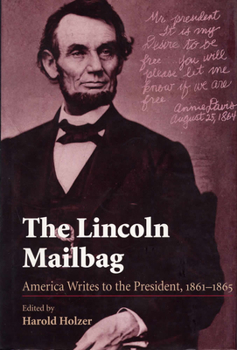
The Lincoln Mailbag: America Writes to the President, 1861-1865

Select Format
Select Condition 
Book Overview
During his four years in the White House, Abraham Lincoln received between 250 and 500 letters a day--not only correspondence from public officials, political allies, and military leaders but from ordinary Americans of all races who never knew the president yet nonetheless felt the urge to share their views with him. Harold Holzer, the editor of Dear Mr. Lincoln: Letters to the President, dips once again into Lincoln's bulging mailbag to assemble and annotate a volume of letters, many of them never-before-published, that the American people wrote to their president during the Civil War--correspondence that offered praise, criticism, advice, threats, abuse, and appeals for help and for special favors from men and women throughout the country. Significantly, this collection may be more representative of the mood of the country at the time than Lincoln might have known; it includes letters from black Americans, originally routed to the War Department's Colored Troops Bureau, that Lincoln never saw. Ed D. Jennings, who simply wanted clarification of his status, writes: "Some Reckon and others guess But what I wish to know is this, what do you mean to do with us Col[ore]d population are we to suffer and our enemies reap or can we Reap now I was brought up a farmer and if I can have a hut in my own native land and a little help that will suffice me." "At a single reading," Holzer notes in his preface, Lincoln's staff "might handle: requests for political appointments (they might come from an ex-President, a New York archbishop, even Lincoln's own minister); suggestions for how better to manage the war; requests for autographs, locks of hair, and personal appearances; presumptuous political advice; rhymes, hymns, epistles--and on one occasion, sixteen pages of vicious abuse in verse--from amateur poets; and gifts and tokens that included food, drink, clothing, pictures, and sculptures." Holzer has rescued these voices--sometimes eloquent, occasionally angry, often poignant, at times poetic--from the obscurity of the archives of the Civil War. The letters, of course, speak for themselves, but Holzer's introduction and annotations provide historical context for events and people described as well as for those who wrote so passionately to their president in Lincoln's America.
Format:Hardcover
Language:English
ISBN:080932072X
ISBN13:9780809320721
Release Date:August 1998
Publisher:Southern Illinois University Press
Length:288 Pages
Weight:1.45 lbs.
Dimensions:1.1" x 6.4" x 9.6"
Customer Reviews
2 ratings
Fascinating slice of Civil War-era life
Published by Thriftbooks.com User , 19 years ago
This book, a sequel of sorts to Mr. Holzer's 1993 volume 'Dear Mr. Lincoln,' gathers together even more letters than Americans from all walks of life wrote to the President. Mr. Holzer is a Civil War and Lincoln expert, so he really knows his stuff. As he explains in the foreword, many of the letters he had decided for various reasons to leave out of the original volume are now included here. What makes this collection of letters so special is that many of them were never even seen by President Lincoln, and of the ones seen, many of them were never endorsed or answered. It was for that reason that Mr. Holzer originally thought such letters didn't merit being included, but then he realised the value of including them, particularly since many of them were written by African-Americans. They'd already been ignored once, and didn't deserve to be marginalised and written off again nearly 150 years later for the same reasons they'd been excluded before. People wrote to President Lincoln because they felt that he was a man of the people and would therefore understand their hopes, dreams, worries, and fears. He didn't appear to them like some out of touch government bigwig who didn't care for the common people; due to his humble origins, they felt as though he were one of them. The subjects include the issue of equal pay for African-American soldiers, old widowed mothers wanting their sons, their sole source of support, back from the Army, a Harvard professor warning him that his oldest son Robert was doing pretty poorly at school, people writing to him about their warfare-related inventions, people (a number of them his relatives) wanting jobs in government (even local government), people who sent gifts (such as socks, scarves, gloves, hams, and flags), people requesting he appear or at least send a speech to their charity balls, congratulations on his re-election, warnings of assassination plots (such as the letter from the less-than-literate West Virginia man who hid inside of a wheat bin to eavesdrop on a conversation between some suspicious characters he worked with), and a man who wanted to start a Lincoln Club (but only on the precondition that the President rescind the Emancipation Proclamation!). Among my favorites were the letter written by Karl Marx (and signed by many of his colleagues) congratulating him on his re-election and lauding him for being such a friend of the common people and freeing the slaves, and the long threatening religious diatribe in verse (so long it was written by two different people) sent all of the way from New Zealand. Though most people are traditionally used to studying history through the eyes of the ruling classes and the leaders of government, the people who supposedly make history, this book gives a valuable look into what life was like for ordinary American citizens during the Civil War. In many cases, the view of history provided through the eyes of the common people is even more interesting, and far more pe
Worthy sequel to Holzer's first volume about Lincoln's mail
Published by Thriftbooks.com User , 28 years ago
I had bought Harold Holzer's 1993 book "Dear Mr. President" and enjoyed it tremendously. That book dealt with the mail that ordinary and famous people from around the world sent to Abraham Lincoln during his term as U.S. President. Now, Holzer has produced a sequel book, "The Lincoln Mailbag", which contains even more letters written to Lincoln. A large number in this new volume consists of mail Lincoln never even saw, such as correspondence from black Americans. These two books by Holzer offer a fresh, new insight into the world of President Lincoln which is far more interesting than the ordinary, standard Lincoln biographies which seem to pop up every 6 months or so.
Copyright © 2026 Thriftbooks.com
Terms of Use | Privacy Policy | Do Not Sell/Share My Personal Information | Cookie Notice | Cookie Preferences | Accessibility Statement
ThriftBooks ® and the ThriftBooks ® logo are registered trademarks of Thrift Books Global, LLC
ThriftBooks ® and the ThriftBooks ® logo are registered trademarks of Thrift Books Global, LLC
