


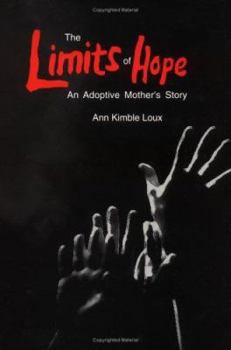
The Limits of Hope: An Adoptive Mother's Story

Select Format
Select Condition 
Book Overview
"Adopting a child is an act of love. When that child is no longer an infant but has a history of abuse and neglect, integrating it into an existing family is a challenge. Loux tells the story of her family's decision to adopt two sisters removed from their alcoholic biological mother. The adoption agency refused to provide any history of the children's birth parents, though both girls had major psychosocial and genetic problems that caused great stress for the adoptive family. This personal account tells of Loux's attempt to raise these girls along with her three biological children. Unfortunately, it is full of self-pity and guilt. The most interesting part is the conclusion, where she suggests alternatives to traditional adoption for the care of troubled older children."--Library Journal
Format:Hardcover
Language:English
ISBN:0813917107
ISBN13:9780813917108
Release Date:July 1997
Publisher:University of Virginia Press
Length:280 Pages
Weight:1.58 lbs.
Dimensions:1.0" x 6.3" x 9.2"
Grade Range:Postsecondary and higher
Customer Reviews
5 ratings
accepting limits
Published by Thriftbooks.com User , 21 years ago
In many ways the authors eperiences are scary in their simularity to mine. My wife and I adopted two little girls, age 4-5 at the time, from the county after taking months of parenting classes and being given access to all the information that the county had available.... Still we had no realistic idea of how difficult it was going to be and how radically our lives would change. It was like trying to heard cats, they were extreamly impulsive, rebellous and raged at us for everything wrong in their lives, often including physical abuse of us and our house. A few years later we had an unexpected biological child who is in most ways just the opposite of J n L and things really got lively, runnaway, theft, drug and alchol use. At about age 14 we borrowed enough to send the eldest from a mental hospital to a behavior modification program in Utah. She spent about 1.5 years there, it did not make her a "model Child" but did change the direction of her life. Upon her return she made a serious suicide attempt and my wife, declaring she had had enough, took the youngest child and left me with the two adoptive teenagers. At about this time my mother in law loaned us a copy of "The Limits of Hope", it was a real eye opener for me because her eperiences were so simular to ours. I did not reach the conclusion that a group home would be better for them, we had tried that with the oldest, she just ran away at will from them like she did us, but it did help me to understand that it is not realistic to expect them to be like their younger sister and to try a different direction. I lifted the thousand and one rules, complete with rewards and punishments, that we had imposed in a failed attempt to provide "structure" and just settled for open communication and letting them suffer the consiaquences of their own actions. I have had to bail both of them out at one time or another, wound up home schooling them both but the anger level has gradually subsided as they learn to take charge of their own lives. The eldest is now a sophmore in college and the youngest.....I still have hope, limited of course. So, while I reached some different conclusions than the author, the book came to me at a critical time in my life and helped me understand that I needed to see my adoptive children as they are, not as I/we wished them to be. And, it helped me admit to myself and them that I did feel differently about them than I do about their sister and give up the romatic notion that we can treat all of them the same and expect the same results.
Hurrah from another outlaw
Published by Thriftbooks.com User , 25 years ago
As a parent whose experiences are similar to Loux's I was grateful beyond words that someone has had the courage to publish a story like the ones I hear in whispers about "my friend, my sister, my cousin" who has experienced a troubled adoption. I mean the stories where there isn't an upbeat ending about the power of faith, or hope or unconditional love. Why do I hear so many of these stories and see so few in print? It's time that people who have spent countless days and nights and dollars in a fruitless quest to reach a troubled child be heard and believed and not blamed. Thank you Ann Kimble Loux.
Unlimited hope
Published by Thriftbooks.com User , 26 years ago
An emotionally honest account that puts parenting in perspective. A must-read for mothers everywhere who have experienced the guilt and helplessness of parenting, both biological and adoptive children.
this book is wonderful for adoptive families.
Published by Thriftbooks.com User , 26 years ago
I am the sister of an adopted girl who brought great challenge and heart break into our family. I truely related to this book and in a way felt healed by reading it.
Review by a Child Protection Worker
Published by Thriftbooks.com User , 27 years ago
I first heard the Loux family story by watching Dateline-NBC profile in November 1997. I frantically put in a tape because of its apparent application to the work that I do which is in the area of Fetal Alcohol Syndrome. I was struck with the fact that the adoptive daughters of Ann and Mike have almost every facial and behavioural characteristic of children/adults with this syndrome but never once did anyone suggest that the damaged caused to these young girls happened primarily prenatally due to alcohol exposure. The early childhood traumas, although significant, have likely played less to do with the long term outcome than the Loux family has understood. I welcome an opportunity to share what I know and I hope the family looks into the possibility that the girls "damage" is Fetal Alcohol Syndrome and not due to "bad" parenting. My heart bleeds for Ann...who still believes she is to blame for the outcomes. Prenatal alcohol exposure causes brain damage that is permanent and irreversable.
Copyright © 2026 Thriftbooks.com Terms of Use
| Privacy Policy | Do Not
Sell/Share My Personal Information | Cookie Policy | Cookie Preferences | Accessibility Statement
ThriftBooks® and the ThriftBooks® logo are registered trademarks of Thrift Books Global, LLC
ThriftBooks® and the ThriftBooks® logo are registered trademarks of Thrift Books Global, LLC
