


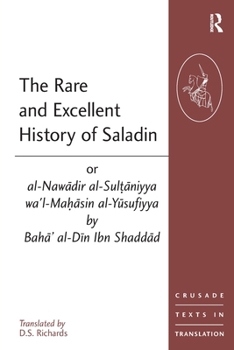
The Rare and Excellent History of Saladin or al-Nawadir al-Sultaniyya wa'l-Mahasin al-Yusufiyya by Baha' al-Din Ibn Shaddad

Select Format
Select Condition 
Book Overview
Revised
Format:Paperback
Language:English
ISBN:0754633810
ISBN13:9780754633815
Release Date:August 1970
Publisher:Routledge
Length:278 Pages
Weight:0.87 lbs.
Dimensions:0.6" x 6.1" x 9.2"
Customer Reviews
2 ratings
Great Crusades Counterpoint!
Published by Thriftbooks.com User , 17 years ago
DS Richards' 2002 265-page paperback translation of Ibn Shaddad's 12th century history of sultan Saladin (1138-1193) will likely become a classis for western Islamic studies. This work meticulously presents the story of the great Damascene general from 1163 through 1228 (as its first manuscript is finished). The book is comfortably resourced with three maps and three pages of bibliography. From his youthful extractions of hostile Muslim Egyptian leaders to his life long war with European Crusaders, Shaddad documents Saladin as a brilliant military strategist, compassionate general, and devoted son of Islam. Readers are offered glimpses into the sultan's personal, family, and religious life. His male family members (from father, to sons, uncles, and cousins) are introduced and carefully positioned in Saladin's rise to greatness. His kinsmen were his closest allies and most trusted confidants. This narrative is a great counterpoint, from the Muslim point of view, for the end of the 2nd Crusade and the beginning of the 3rd Crusade. Richards' translation describes with detailed precession the repelled European invasion of Egypt (1174), the resounding Crusader defeat at Sepphoris (1183), the fall of Crusader Jerusalem (1187), the Crusader victory at the 2nd battle for Tyre (1189), Saladin's peace with Richard the Lionhearted (1192), and much more. Saladin's mercy with hostages, generosity with Muslims, preference to fight on Fridays, public building projects, political appointments, and determined prayer life (as a preparation for battle) are explained. (Interestingly, Shaddad lumps all European crusading warriors in to the common appellation of "Franks"- humorously, for those with a French prejudice, cursing them each all the while). Military historians will be particularly interested to discover Saladin's siege engines. Shaddad describes in detail the sultan's siege towers, trebuchets, and mine works. Saladin was particularly adept in dealing with opponent deployment, strategy, and technology. "The Rare and Excellent History of Saladin" translation seems accurate and astute- even with the occasional language bias. For example, throughout, the text uses the word "God" while Shaddad most certainly wrote "Allah". ("Allah", as a title from the ancient pagan Arabic pantheon was adopted by Mohammad as title for his deity and not necessarily as correspondent to the Arabic word "God". Perhaps, Richards intends a subtle personal faith statement of his own using herein the translated word. A more accurate rendering would simply use the word "Allah". ) Such a translation misstep, however, does not grossly detract from the story. Because the book is fairly technical in it presentation it is recommended to all students of the Crusades, military history buffs, and Saladin aficionados.
Excellent primary source.
Published by Thriftbooks.com User , 18 years ago
'The forces of Islam surrounded the forces of unbelief and impiety on all sides, loosed volleys of arrows at them and engaged them hand to hand.' 'I fear to make peace, not knowing what may become of me. Our enemy will grow strong, now that they have retained these lands.' After the 14th revision I shall just say I enjoyed reading this book. It is a good read as well as being a must have for anyone with even a remote interest in the crusades, the military orders (mentioned in passing a few times), the history of the area, the history of religion and so on. I must also mention pleasure of seeing the view from the other side which this enabled me to do. It was interesting to see (among others) Richard the Lionheart's name always followed by a phrase similar to 'may God forsake him'.
Copyright © 2026 Thriftbooks.com
Terms of Use | Privacy Policy | Do Not Sell/Share My Personal Information | Cookie Policy | Cookie Preferences | Accessibility Statement
ThriftBooks ® and the ThriftBooks ® logo are registered trademarks of Thrift Books Global, LLC
ThriftBooks ® and the ThriftBooks ® logo are registered trademarks of Thrift Books Global, LLC
