


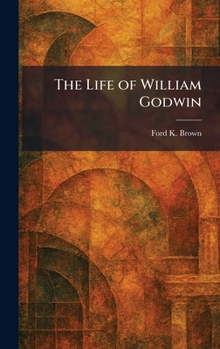
The Life of William Godwin

"The Life of William Godwin" is an exhaustive and scholarly biography detailing the personal history and intellectual evolution of one of the most significant political theorists of the late eighteenth and early nineteenth centuries. Written by Ford K. Brown, this work explores the career of the man widely recognized as the father of philosophical anarchism. Godwin's life was deeply intertwined with the radical political and social movements of his time, and this volume provides a deep analysis of the impact of his most famous work, "An Enquiry Concerning Political Justice".
The biography also offers a detailed look at Godwin's private life, most notably his marriage to the early feminist writer Mary Wollstonecraft and his relationship with his daughter, Mary Shelley, the author of "Frankenstein". Brown examines Godwin's shifting fortunes, from his years as a celebrated radical leader to his later period of struggle and financial difficulty. By documenting his relationships with other literary and philosophical luminaries such as Percy Bysshe Shelley, Samuel Taylor Coleridge, and Charles Lamb, the work provides a vivid window into the intellectual and cultural landscape of the Romantic era. "The Life of William Godwin" is an essential study for readers interested in the development of modern political thought and the history of English radicalism.
This work has been selected by scholars as being culturally important, and is part of the knowledge base of civilization as we know it. This work was reproduced from the original artifact, and remains as true to the original work as possible. Therefore, you may see the original copyright references, library stamps (as most of these works have been housed in our most important libraries around the world), and other notations in the work.
This work is in the public domain in the United States of America, and possibly other nations. Within the United States, you may freely copy and distribute this work, as no entity (individual or corporate) has a copyright on the body of the work.
As a reproduction of a historical artifact, this work may contain missing or blurred pages, poor pictures, errant marks, etc. Scholars believe, and we concur, that this work is important enough to be preserved, reproduced, and made generally available to the public. We appreciate your support of the preservation process, and thank you for being an important part of keeping this knowledge alive and relevant.
Customer Reviews
ThriftBooks ® and the ThriftBooks ® logo are registered trademarks of Thrift Books Global, LLC
