


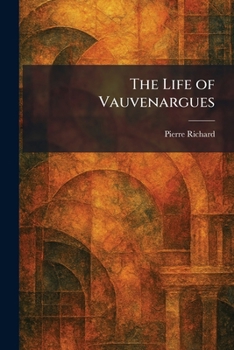
The Life of Vauvenargues

"The Life of Vauvenargues" is a detailed biographical investigation into the short yet significant life of Luc de Clapiers, marquis de Vauvenargues. A pivotal figure in the 18th-century French intellectual landscape, Vauvenargues is celebrated for his contributions as a moralist and writer during the Enlightenment. Pierre Richard provides a thorough examination of the man behind the maxims, exploring his upbringing, his service in the French army, and his eventual shift toward a life of contemplation and correspondence with contemporaries like Voltaire.
The work highlights the core themes of Vauvenargues' philosophy, which often emphasized the nobility of the human spirit and the importance of sentiment alongside reason. Unlike the more cynical perspectives of his era, Vauvenargues offered a more optimistic view of human nature, a theme that Richard explores with sensitivity and historical depth. This volume serves as an invaluable resource for understanding the transition from classical thought to the burgeoning ideals of the Enlightenment. "The Life of Vauvenargues" is a testament to a life defined by intellectual rigor and moral integrity, offering readers a window into the mind of a writer who influenced generations of thinkers despite his untimely passing.
This work has been selected by scholars as being culturally important, and is part of the knowledge base of civilization as we know it. This work was reproduced from the original artifact, and remains as true to the original work as possible. Therefore, you may see the original copyright references, library stamps (as most of these works have been housed in our most important libraries around the world), and other notations in the work.
This work is in the public domain in the United States of America, and possibly other nations. Within the United States, you may freely copy and distribute this work, as no entity (individual or corporate) has a copyright on the body of the work.
As a reproduction of a historical artifact, this work may contain missing or blurred pages, poor pictures, errant marks, etc. Scholars believe, and we concur, that this work is important enough to be preserved, reproduced, and made generally available to the public. We appreciate your support of the preservation process, and thank you for being an important part of keeping this knowledge alive and relevant.
Related Subjects
Biographical Biographies Biographies & History Biography & History History PhilosophyCustomer Reviews
ThriftBooks ® and the ThriftBooks ® logo are registered trademarks of Thrift Books Global, LLC
