


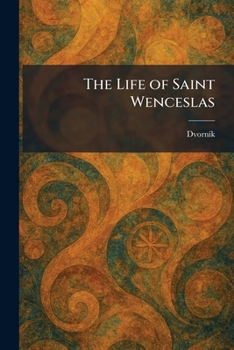
The Life of Saint Wenceslas

"The Life of Saint Wenceslas" offers a compelling historical and hagiographical account of one of Central Europe's most revered figures. Written by the distinguished historian Francis Dvornik, this work delves into the life, martyrdom, and enduring legacy of the tenth-century Duke of Bohemia. As the patron saint of the Czech people, Wenceslas represents a pivotal era in the Christianization of the Slavic lands and the consolidation of the Bohemian state.
Dvornik examines the political and religious tensions of the medieval period, providing context for the internal conflicts and external pressures that shaped Wenceslas's reign and led to his eventual assassination. The narrative explores the development of the tradition surrounding the "Good King," tracing how a historical ruler was transformed into a lasting symbol of piety and national identity. This scholarly examination serves as an essential resource for those interested in medieval European history, the lives of the saints, and the cultural foundations of the Czech nation. By balancing historical evidence with the spiritual significance of the saint's life, the book provides a comprehensive look at a figure whose influence remains central to Central European heritage.
This work has been selected by scholars as being culturally important, and is part of the knowledge base of civilization as we know it. This work was reproduced from the original artifact, and remains as true to the original work as possible. Therefore, you may see the original copyright references, library stamps (as most of these works have been housed in our most important libraries around the world), and other notations in the work.
This work is in the public domain in the United States of America, and possibly other nations. Within the United States, you may freely copy and distribute this work, as no entity (individual or corporate) has a copyright on the body of the work.
As a reproduction of a historical artifact, this work may contain missing or blurred pages, poor pictures, errant marks, etc. Scholars believe, and we concur, that this work is important enough to be preserved, reproduced, and made generally available to the public. We appreciate your support of the preservation process, and thank you for being an important part of keeping this knowledge alive and relevant.
Customer Reviews
ThriftBooks ® and the ThriftBooks ® logo are registered trademarks of Thrift Books Global, LLC
