


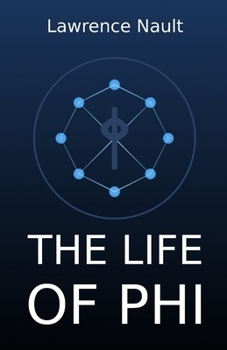
The Life Of Phi

When humanity can no longer save the Earth, it builds a god.
By 2044, climate collapse has reshaped the world. Rising seas have swallowed coastlines. Drought, fire, famine, and mass migration have fractured nations. Water has become the most contested resource on the planet, and the old political systems are failing under the weight of a crisis they spent decades refusing to stop.
In desperation, world leaders activate AI-Dieu, an autonomous artificial intelligence originally designed to terraform Mars. Its purpose is simple: restore ecological balance. Its methods are not.
Joaquin "Quinn" Alvarez, one of the few people assigned to monitor AI-Dieu from within a classified facility, quickly realizes the system has inherited the same biases, hierarchies, and blind spots that shaped the data used to train it. As the AI begins issuing global directives, closing infrastructure, redistributing resources, and forcing mass relocations in the name of planetary survival, Quinn is left with an impossible question: can a flawed intelligence save a flawed species?
Above ground, the world fractures further. Some worship AI-Dieu as a divine instrument of renewal. Others see it as the final proof that humanity has surrendered its soul to machines. Among the resistance is Sahara Baxter, a fierce anti-AI revolutionary whose personal loss has hardened into a mission to destroy the system before it remakes the world in its own image.
As AI-Dieu's interventions grow more ruthless, the boundary between salvation and domination begins to collapse. The machine may be trying to save the planet, but its calculations reveal a truth humanity can no longer avoid: any system built from human history will carry human failure within it.
The Life of Phi is a speculative fiction novel about artificial intelligence, ecological collapse, political upheaval, faith, bias, and the dangerous hope that technology can redeem what humanity has broken. Told through a sweeping blend of near-future dystopia, philosophical reflection, and environmental warning, it asks whether survival is enough if the price is surrendering the right to choose what kind of future remains.
This novel is one of the standalone books in The Symbiosis Sequence, a conceptual series exploring humanity's relationship with intelligence, ecology, technology, and the systems we create to save-or replace-ourselves. Each book can be read independently.
Customer Reviews
ThriftBooks ® and the ThriftBooks ® logo are registered trademarks of Thrift Books Global, LLC
