


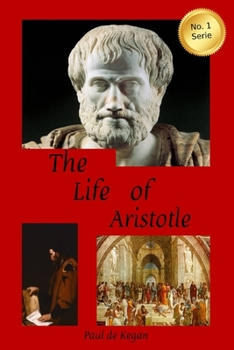
The Life of Aristotle
No Customer Reviews

Life is ascribed by Aristotle to the presence of a soul, of whose activity it is the manifestation. There is a soul in all living things, whether plants or animals, but in different degrees of complexity. In plants it is purely nutritive; in animals, even of the lowest grade, it is at once nutritive and sensory; in higher animals, nutritive, sensory, and locomotive; and, in the highest of all, not only such but also intellectual.This soul, or vital principle, is not itself corporeal, but yet is inseparable from the body; and the first question that presents itself is, in what region of the body is it located. It is, says Aristotle, to be found to some extent in every part. In plants the phenomena of cuttings and grafts clearly show this to be the case; for each such detached piece can reproduce the entire parent-form. In some of the lower animals, such as centipedes, the fact is also apparent enough; for, if such an animal be cut in two, each part retains sensibility and power of motion. But, as we get higher in the scale of life, this diffusion of the soul to all parts of the body becomes less and less apparent-being still noticeable, however, in such an animal as the tortoise, which shows signs of life even after removal of the heart-and it altogether vanishes in the highest animals, where centralisation has been carried to the utmost extent.
Format:Paperback
Language:English
ISBN:B08R6TMV72
ISBN13:9798585231292
Release Date:December 2020
Publisher:Independently Published
Length:50 Pages
Weight:0.18 lbs.
Dimensions:0.1" x 6.0" x 9.0"
Related Subjects
HistoryCustomer Reviews
0 rating
Copyright © 2026 Thriftbooks.com Terms of Use
| Privacy Policy | Do Not
Sell/Share My Personal Information | Cookie Policy | Cookie Preferences | Accessibility Statement
ThriftBooks® and the ThriftBooks® logo are registered trademarks of Thrift Books Global, LLC
ThriftBooks® and the ThriftBooks® logo are registered trademarks of Thrift Books Global, LLC
