


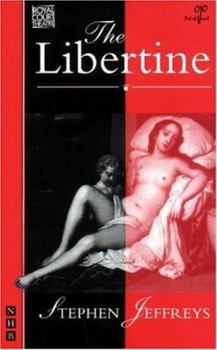
The Libertine


A historical romp with real bite, Stephen Jeffreys's "The Libertine" has received several major stage productions and was filmed with Johnny Depp and John Malkovich. John Wilmot, Earl of Rochester, is... This description may be from another edition of this product.
Format:Paperback
Language:English
ISBN:1854592777
ISBN13:9781854592774
Release Date:September 1995
Publisher:Nick Hern Books
Length:96 Pages
Weight:0.30 lbs.
Dimensions:7.8" x 0.3" x 5.1"
Customer Reviews
4 ratings
The Libertine
Published by Thriftbooks.com User , 17 years ago
Cast: 8m., 5w. (Doubling or extras possible.) "You will not like me. No, I say you will not," taunts the Earl of Rochester at the opening of this riotously funny and intriguing comedy of sexual manners...based on the life of John Wilmot, second Earl of Rochester (1647-80), poet and satirist. "The Libertine presents Rochester as the ultimate, sensation-seeking product of a decadent era. 'You see I must always exceed, or I don't feel I'm alive,' says the Earl. And when confronted with a comedy based on his life, George Etherege's Man of Mode, he heatedly remarks,'I am the age.'" (NY Times) --- from book's back cover
Stephen Jeffreys The Libertine
Published by Thriftbooks.com User , 18 years ago
Fantastic read - this one reads really quick and is quite a page turner. Made me want to go and watch the recent film adaptation. I love each character for their wit and honesty; they are truly ones to remember. Well done, Mr. Jeffreys.
Excellent treatment of Rochester's paradoxes
Published by Thriftbooks.com User , 19 years ago
Jeffreys' portrait of Rochester seems designed to titillate Rochester scholars for the play is packed full of references to Rochester's poetry (both the popular lampoons & satires and the more arcane meditations on "nothing" etc...). Though Jeffreys admits that he takes some liberties with the material he deals with the most infamous incidents in the life of Rochester (hatred of poet laureate Dryden, disgust at excesses of Charles II, breaking of the Kings sundial, abandoning his friend Downs to die at the hands of a night watchman during one of the merry gangs many riotous jests, the impersonation of Italian mountebank Dr. Alexander Bendo, the alleged training of and affair with the actress Elizabeth Barry, portrait with monkey). Any Restoration or Rochester scholar will be impressed and delighted with the amount of historical and literary research and detail Jeffreys packs in to this play. But the play is not just a reiteration of already known facts and incidents that are already part and parcel of Rochester scholarship/lore; this play also attempts to offer an original take on the world's most famous libertine. Its interesting to note that Jeffreys' THE LIBERTINE was originally written to be performed as a companion piece with the most famous libertine play of the Restoration, Etherege's MAN OF MODE. Most scholars agree that the lead character of Etherege's play, Dorimant, was based on a kind of idealised version of his friend Rochester. Some critics would say that Etherege crafted a portrait of his notorious friend but a portrait that Restoration audiences could admire for Dorimant like Rochester is a cool patrician libertine but unlike Rochester Etherege's Dorimant never makes a move designed to upset or lampoon the social world that he inhabits but is always an affable charmer/companion with friends and ladies (his treatment of Mrs. Loveit excepted), and his winning ways make him the toast of the town and the most sought after lover and socialite in all of London. You could say that Jeffreys' portrait of Rochester in THE LIBERTINE is designed to counter Etherege's too flattering portrait with a more gritty and more realistic portrait of his own. This is especially interesting as Rochester himself was always interested in offering a more realistic or more natural version of life than any of his literary companions and competitors were offering. Etherege's portrait is complex though and it does show Dorimant/Rochester as a consummate social performer who is capable of always knowing just what to say to each social player (and this can be viewed as a criticism not a compliment). Jeffreys wants us to see the other side of Rochester, the side that is only implied in Etherege's portrait. Taking his cues from Rochester's own poetrry Jeffreys fashions a much more complex and paradoxical creature. Jeffreys' "Rochester" talks as if he did not really want to be liked or admired. He talks as if he preferred "reality" to "art" and yet his actio
Inspiring a Movie
Published by Thriftbooks.com User , 20 years ago
This is a pretty good book about John Wilmot (aka the Earl of Rochester), who is not well known, but surely will be soon - due to a movie starring Johnny Depp coming out. As a poet, Wilmot is entertaining and virile. He is obscene and satirical. "The Libertine" does a good job of expressing this, sharing his life, exploring his reasoning for his satire of King Charles, his heroism, the balance between reason and humor that seems to be the dichotomy of Wilmot. We'll see how well the movie does. But, it would be great if people starting actually reading his poetry. Another book I recently enjoyed that is like a modern-equivalent of Wilmot is "The Loony," a story about a guy also sort of exiled, who is also a libertine, also afflicted with a penchant for perversity, and also destined for a bad end. It was interesting to read one after the other, as they shared so many interesting attributes. I look forward to the movie, and hope it bring Wilmot more readers.
Copyright © 2026 Thriftbooks.com Terms of Use
| Privacy Policy | Do Not
Sell/Share My Personal Information | Cookie Policy | Cookie Preferences | Accessibility Statement
ThriftBooks® and the ThriftBooks® logo are registered trademarks of Thrift Books Global, LLC
ThriftBooks® and the ThriftBooks® logo are registered trademarks of Thrift Books Global, LLC
