


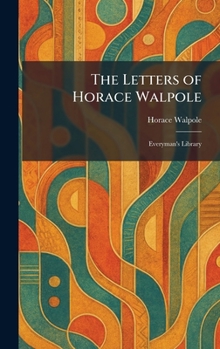
The Letters of Horace Walpole: Everyman's Library

"The Letters of Horace Walpole" offers an unparalleled window into the social, political, and cultural landscape of 18th-century England. As one of the most prolific and celebrated letter writers in the English language, Walpole provides a witty and insightful chronicle of his era. This selection captures the essence of a man who moved within the highest circles of British society, offering readers a front-row seat to the unfolding history of the Georgian period.
Through his vast correspondence, Walpole delivers vivid descriptions of significant historical events, sharp commentary on contemporary figures, and reflections on the evolving artistic tastes of his time. From discussions of art and antiquarianism to the intricate gossip of the court and the nuances of political life, his prose is characterized by elegance and observational brilliance. Horace Walpole is not only remembered as a master of the letter form but also as a key figure in the development of the Gothic novel, and these writings reveal the intellectual depth that fueled his creative and historical interests.
This collection serves as both a vital historical record and a masterpiece of English literature. It remains an essential resource for anyone interested in the life, manners, and mindset of the 1700s, seen through the eyes of one of its most astute and entertaining observers.
This work has been selected by scholars as being culturally important, and is part of the knowledge base of civilization as we know it. This work was reproduced from the original artifact, and remains as true to the original work as possible. Therefore, you may see the original copyright references, library stamps (as most of these works have been housed in our most important libraries around the world), and other notations in the work.
This work is in the public domain in the United States of America, and possibly other nations. Within the United States, you may freely copy and distribute this work, as no entity (individual or corporate) has a copyright on the body of the work.
As a reproduction of a historical artifact, this work may contain missing or blurred pages, poor pictures, errant marks, etc. Scholars believe, and we concur, that this work is important enough to be preserved, reproduced, and made generally available to the public. We appreciate your support of the preservation process, and thank you for being an important part of keeping this knowledge alive and relevant.
Customer Reviews
ThriftBooks ® and the ThriftBooks ® logo are registered trademarks of Thrift Books Global, LLC
