


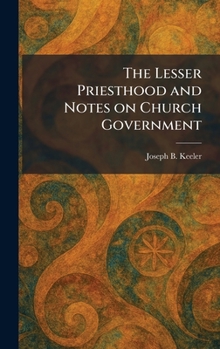
The Lesser Priesthood and Notes on Church Government

"The Lesser Priesthood and Notes on Church Government" is a comprehensive manual and theological guide detailing the structure, duties, and administrative functions of the Aaronic Priesthood within the Latter-day Saint tradition. Written by Joseph B. Keeler, a prominent educator and authority on ecclesiastical order, this work serves as an essential resource for understanding the practical and spiritual roles of church leadership at the local level.
The volume provides a systematic exploration of the offices of deacon, teacher, priest, and bishop, outlining their specific responsibilities and the scriptural foundations for their authority. Beyond simple instruction, Keeler offers profound insights into the organizational principles that sustain the church, including detailed notes on quorum governance, meeting conduct, and the historical development of priesthood offices. By focusing on the "Lesser Priesthood," the text clarifies the intricate balance between divine mandate and procedural efficiency required for religious service.
Ideal for students of theology, historians of the American religious experience, and those interested in the administrative evolution of The Church of Jesus Christ of Latter-day Saints, this book remains a significant literary contribution to the study of 20th-century religious governance and praxis.
This work has been selected by scholars as being culturally important, and is part of the knowledge base of civilization as we know it. This work was reproduced from the original artifact, and remains as true to the original work as possible. Therefore, you may see the original copyright references, library stamps (as most of these works have been housed in our most important libraries around the world), and other notations in the work.
This work is in the public domain in the United States of America, and possibly other nations. Within the United States, you may freely copy and distribute this work, as no entity (individual or corporate) has a copyright on the body of the work.
As a reproduction of a historical artifact, this work may contain missing or blurred pages, poor pictures, errant marks, etc. Scholars believe, and we concur, that this work is important enough to be preserved, reproduced, and made generally available to the public. We appreciate your support of the preservation process, and thank you for being an important part of keeping this knowledge alive and relevant.
Customer Reviews
ThriftBooks ® and the ThriftBooks ® logo are registered trademarks of Thrift Books Global, LLC
