
Skip to content
Scan a barcode
Scan
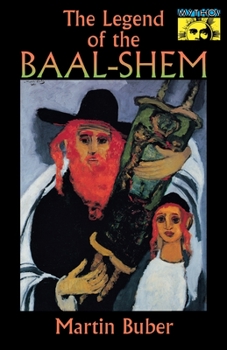
Paperback The Legend of the Baal-Shem Book

ISBN: 0691043892

ISBN13: 9780691043890

The Legend of the Baal-Shem

Select Format

Select Condition ThriftBooks Help Icon

Recommended

Format: Paperback

Condition: Good

$8.39
Save $28.61!
List Price $37.00
Almost Gone, Only 1 Left!

Book Overview

The Jewish philosopher Martin Buber spoke directly to the most profound human concerns in all his works, including his discussions of Hasidism, a mystical-religious movement founded in Eastern Europe by Israel ben Eliezer, called the Baal-Shem (the Master of God's Name). Living in the first part of the eighteenth century in Podolia and Wolhynia, the Baal-Shem braved scorn and rejection from the rabbinical establishment and attracted followers from among the common people, the poor, and the mystically inclined. Here Buber offers a sensitive and intuitive account of Hasidism, followed by twenty stories about the life of the Baal-Shem. This book is the earliest and one of the most delightful of Buber's seven volumes on Hasidism and can be read not only as a collection of myth but as a key to understanding the central theme of Buber's thought: the I-Thou, or dialogical, relationship.

"All positive religion rests on an enormous simplification of the manifold and wildly engulfing forces that invade us: it is the subduing of the fullness of existence. All myth, in contrast, is the expression of the fullness of existence, its image, its sign; it drinks incessantly from the gushing fountains of life."--Martin Buber, from the introduction

Customer Reviews

3 ratings

A Hasid on the great founder of Hasidism

Buber is the Jewish teacher who more than any other helped bring the attention of the West to Hasidism. The Baal Shem Tov (1700-1760)is the founding teacher of Hasidism. In this work Buber tells twenty stories of the Baal Shem and reveals to us a world of deep faith, of deep connection of the Jew with nature and all creation, of the special hitlahavut or enthusiasm which the Hasid brings in his relation to the Divine. Buber is a Hasid of Hasidism, and he tells the stories of its great founder with the same kind of enthusiasm the movement itself generated throughout the Jewish world.

Greet the day which enchains thee . . .

Martin Buber (1878 - 1965) was a German Jewish philosopher-theologian and one of the most original and influential thinkers of the 20th Century. In this work, he does not set forth his own theology so much as trace one of its roots. "The [Hasidic] legend is the myth of I and Thou [the title of Buber's most famous work], of the caller and the called, the finite which enters into the infinite and the infinite which has need of the finite." (13) Buber provides a brief introduction and an essay on the spiritual life of the Hasidim (both written in somewhat difficult, mystical language), but the bulk of this book is Buber's retelling of 20 stories from the life of the Ba'al Shem Tov. The stories are beautiful, told in simple and direct language, and convey the lessons that the Ba'al Shem taught (or was taught -- the Ba'al Shem occasionally errs himself and has to be guided back to the correct path). The lessons are about living with dedication, uniting with God in joy, overcoming the evil impulse, and finding the holy in everything around us. Greet the day which enchains thee . . . art thou not already freed?These stories are for everyone who is interested in the mystical experience. You will need to have some basic background in Kabbala to understand some aspects of some of the stories (the chapter on Kabbala in Barry Holtz' "Back to the Sources" is probably enough), and you may want to review the Glossary before starting on the stories if you are not familiar with basic Jewish religious terms. Highly recommended.

Beautiful

Buber begins the book by giving an introduction to the Hasidim, the ultra-orthodox, mystically inclined branch of Judaism founded by Rabbi Israel ben Eliezer, a.k.a. the Baal-Shem Tov (which literally means "master of the good name" = master of God's name). Buber then proceeds to relate 20 stories/legends about the Baal-Shem's life and teaching, followed by a glossary of the key terms in the book.The wonderful thing about this book is its beautiful, poetic simplicity. The language is poetic, and the stories are profound because they show that in the middle of the 1700's, God became a vibrant, living reality to a group of common folk in eastern Europe. "God desires the heart," taught the Baal-Shem.On a personal note, this book opened my eyes to a side of both life and God that I have never seen before. Live life with joy and humility, live it deeply and with passion. God rejoices and dances with us in our joy."God desires the heart." How simple, yet how utterly profound.
Copyright © 2025 Thriftbooks.com Terms of Use | Privacy Policy | Do Not Sell/Share My Personal Information | Cookie Policy | Cookie Preferences | Accessibility Statement
ThriftBooks ® and the ThriftBooks ® logo are registered trademarks of Thrift Books Global, LLC

GoDaddy Verified and Secured