
Skip to content
Scan a barcode
Scan
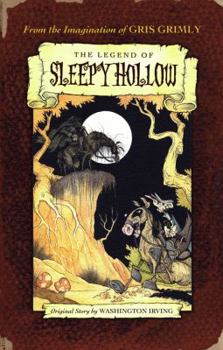
Hardcover The Legend of Sleepy Hollow Book

ISBN: 1416906258

ISBN13: 9781416906254

The Legend of Sleepy Hollow

Select Format

Select Condition ThriftBooks Help Icon

Recommended

Format: Hardcover

Condition: Very Good*

*Best Available: (ex-library)

$8.59
Save $11.40!
List Price $19.99
Only 7 Left
Save to List

Book Overview

Are all the lights on? Is there a parent in the house? Are the windows shut and locked? Double-check They HAVE to be if you are going to read this book, which is undoubtedly the scariest rendition of one of the greatest ghost stories ever told: The Legend of Sleepy Hollow. While you may have heard of Ichabod Crane, Katrina Van Tassel, and the Headless Horseman, you've never SEEN them quite like this -- through the macabre imagination of the inimitable Gris Grimly. So, take a deep breath and take a long look. And you may want to bring a flashlight to bed with you tonight....

Customer Reviews

5 ratings

You feel that you are there.

As with many readers, my previous exposure to this story was the Disney Cartoon and the ghoulish adaptation by Johnny Depp and Christina Ricci in the Movie "Sleepy Hollow" [Blu-ray] (1999). With my purchase of the story, I was catching up on the classics or samples from different writers. I did not realize this was so short of a story and had to get the images out of my head from the films. I am amazed by the good descriptive writing of Washington Irving. I had to set the book down occasionally to look up people and words. Now I ordered information on Hudson and Cotton Mather. I spent a year near the location of the story at West Point. Now I wonder if there was such a place as Sleepy Hollow. This is another example of the book being better than the movie. And I look forward to reading more of Washington Irving. You will be hooked on him also. In any event, it is worth the read.

good reading

Truly an American classic, Washington Irving writes "The Legend of Sleepy Hollow" for easy reading and entertainment. The misadventure of Ichabod is intentionally set for ambiguity and different interpretations to appeal to audiences, limited to neither space nor time. Unlike the popular form of ghost story written in gothic and darkly morbid fashion, Irving's ends his ghost story of the headless Hessian without a definite identity, creating interest from the debates of his true identity. In the above passage is one of the biggest plot points in the short story; it implies a connection between Brom and the disappearance of Ichabod. Irving does not try to exploit the plot twist with elongated descriptions and unnecessarily overt insinuations of Brom's involvement. He goes over it relatively quickly and lightly. He does not aim to register shock values with his words, terrifying and horrifying the reader. In no way does he put to ink repetitive suggestion of Broms Bones being the Headless Hessian, but instead allows the reader to mentally repeat the sentence and his implication in their minds. By allowing the reader's imagination to work for itself, the imagination quietly disturbs the reader with his own thoughts though seeded by Irving are developed by the reader himself. Irving employs ambiguity not only in the ending of his short story but litters ambiguity throughout his work to increase the potential range for his audience and readers. From the young to the old, readers of "The Legend of the Sleepy Hollow" are able to enjoy it for entertainment. However more seasoned readers may be able to see Irving's purpose in writing his short ghost story greater than that of entertainment. Subtlety, so not to distract from the development of the plot and its scare value, Irving creates an onion-layered story with different interpretations at every level. His writing alludes to a greater meaning, but it cannot be verified concretely in his work. Some think the legend is strictly for entertainment, some interpret it as a criticism of the published American writings during his time and others see it as a warning to Americans to not become like England. The uncertainty surrounding "The Legend of Sleepy Hollow" becomes a major factor of its continuing success in the 21st century.

not your average ghost story

At first glance, "The Legend of Sleepy Hollow" appears to be a simple ghost story - granted, with above-average writing - but nevertheless a story with a rather straightforward intent to entertain. But don't let this façade fool you! Author Washington Irving himself has stated that "I have often hid my moral from sight, and disguised it as much as possible by sweets and spices, so that while the simple reader is listening with open mouth to a ghost or a love story, he may have a bolus of sound morality popped down his throat, and be never the wiser for the fraud..." "The Legend of Sleepy Hollow" is no exception. What seems to be a classical myth meant solely to entertain, defies convention with a subtle criticism of tradition and superstition. The reason for this criticism can be found in Irving's life story. The birth of Irving, April 3, 1783, incidentally coincided with the birth of a new nation - the United States of America. He was born five short days before the formal proclamation ending the American Revolution, declaring America a free nation. In fact, Washington Irving was named by his mother after the hero of the new nation, George Washington, whose biography (Life of George Washington) he would ultimately come to write. He was literally a contemporary of the country, and essentially invented American literature. Irving avoided purely patriotic writing, choosing instead to assert patriotic messages in a characteristically circuitous manner. "The Legend of Sleepy Hollow" reflects a critique of Britain's snobbish pride regarding its tradition as opposed to the young America's lack thereof, something Irving dismisses in his story as foolish. "The Legend of Sleepy Hollow" is a short story following the local schoolmaster, Ichabod Crane, in his quest to win the hand of the widely courted local beauty (and local heiress), Katrina Van Tassel, and his eventual downfall. Irving writes the tale from a 3rd person limited point of view, like an observer watching the story unfold, with a few insertions of first person commentary in between. This style not only reflects the entertainment qualities of "Sleepy Hollow," but also allows the reader to follow along with Ichabod's actions in an unbiased observation of his character and emotions. This story is based predominantly on myth and legend, so Irving's style of writing in a detached observational manner heightens the mystery in the story. The outcome of Ichabod's encounter with the Headless Hessian remains unbeknownst to the reader, allowing the readers to attempt to uncover the truth for themselves, and enhancing the ambiguity of Ichabod's fate, as well as the mystery of Sleepy Hollow. This short story is an amazing aesthetic experience as well. Irving provides a satirically humorous depiction of two contrasting characters, Ichabod Crane, and his rival Brom Bones, whose rivalry over Katrina provide for several memorable encounters. In addition, in accordance with the Romantic Irvin

Where The Pocantico Winds Its Wizard Stream

The original 1928 Arthur Rackham edition of Washington Irving's The Legend of Sleepy Hollow (first published in 1819) was one of the most beautifully illustrated versions of the tale ever produced. This Books Of Wonder facsimile of that edition is certainly the finest available today, though folk artist Will Moses' bright retelling runs a close second. Rackham's watercolors for this American classic are very much in keeping with his earlier work, which had established him as the greatest British illustrator of his era. Where much of Irving's tale is painted in the warm autumn hues, Rackham choose to portray Sleep Hollow as not only a place of overwhelming haunts and visions, but as a region existing in a state of permanent, moody twilight. His Sleep Hollow seems perpetually in crepuscular shadow: the last pure rays of the sun have just vanished from the earth, and darkness, though it has not fallen yet, is falling quickly. In the artist's eye, Irving's fireside tale appears to take place not in glorious mid-October, but in storm-swept late November. The illustrator's anthropomorphic and archetypal Sleepy Hollow also magnifies elements of Irving's romantic landscape over and above the necessities of the text. While witches, ghosts, and visions are discussed in the story, Rackham depicts the trees, houses, and countryside of the region as teeming with every kind of fairy, goblin, dryad, and witch, as if calmly revealing to the eyes of man the always coexistent if invisible supernatural life of the Hudson River Valley. His painting of Major Andre's Tree, for example, depicts a traditional European fairytale witch and her black cat familiar walking along the road beneath Andre's tree as if they had every right to be there. It is mankind that is the anxious, insecure, and mortally temporary interloper into this vaster mystical world. Rackham's trees are trees but also fairies, his fairies are fairies but also witches, his witches are human in form but also trees, and the birds resting in the trees, while birds, are sometimes partially fairies. All of these creatures confidently, humorously, and mischievously observe mankind, which, when not perpetually scurrying home to safety, gathers together in nervous groups to share tidings, portents, and spook tales. Irving's remarkably poetic and nuanced prose is in every way worthy of the man who bears the honor of being America's first great writer. Interestingly, the tale is partially a study in contrasts: schoolteacher Ichabod Crane and his rival, the rabble - rousing Brom Bones, though obvious opposites, each also contain elements of the other. Ichabod, though he lives largely in his thoughts and dreams, has a very definite physical side: he plays boisterously outdoors with the town children, and, at the fatal party at the story's end, commands the dance floor in a way that delights and astonishes the other guests. And Brom, who is a great horseman and a fearless fighter, is also known throughout the regio

A Folk Artist's Reconception Of America's Classic

Will Moses' illustrated retelling of Washington Irving's The Legend of Sleepy Hollow rivals Arthur Rackham's near century-old version as the best edition of the book ever published. The Rackham version, with its moody, archetypal illustrations, has the slight edge, as it contains Irving's full original text in addition to Rackham's spectacular artwork. However, Moses's simplification of the narrative is masterfully executed, and the colorful, playful, and numerous paintings which adorn the book have a warm period charm of genuine Americana. Moses portrays the Hudson River Valley as a lush expansive valley not unlike the Garden of Eden on the first day of creation. Happy farmers, their wives and children, cows, geese, ducks and pigs frolic together amid fields of wheat and corn; galleons approach dramatically from the river; and the Catskill Mountains, sun, and sky suggested an infinite panorama and endless horizon full of promise. The story tells us that the Dutch colonists were a superstitious lot, and that the Sleepy Hollow region itself was or seemed to be under a spell of some kind. The farmers and their wives suspected witchcraft; strange music was heard in the air; visions were seen; and the inhabitants themselves lived their lives in a kind of continuous dreamy revery. These tales and superstitions give rise to the legend of the headless horseman, said to be the ghost of a Hessian soldier who lost his head to a canon ball in the war, and now nightly prowling the region in search of it. Moses' nocturnal landscapes of the swamps, hills and the Old Dutch Cemetery under a bright harvest moon are particularly effective. Significantly, these stark, haunted landscapes do not violate the spirit of the book, but enrich its sense of wonder. Moses' Ichabod is a cheerful but somewhat hapless fellow, confident and foolish in equal parts. His Katrina is a strong but innocent blond beauty, and a friend to children. Brom Bones is an appropriately square-shouldered, square-jawed hooligan, rowdy and full of mischief, if not absolute spite. Anyone familiar with the tale knows that it is not a horror story but a folktale, a fireside spook story, and a `legend' as Irving, writing here as Diedrich Knickerbocker, himself called it. This edition of the book is appropriate for children but is equally suitable for adults. Highly recommended.

The Legend of Sleepy Hollow Mentions in Our Blog
The Legend of Sleepy Hollow in Is The Spooky Season Giving You Goosebumps?
Is The Spooky Season Giving You Goosebumps?
Published by Ashly Moore Sheldon • October 06, 2024

As we move into autumn, many readers are drawn to books with a chilling quality. Our newest survey, conducted by Talker Research and commissioned by Thriftbooks, investigated all things related to the spooky genre and what we found turned into a riveting tale. Here are some of our most arresting findings.
The Legend of Sleepy Hollow in The Dawn of Horror: The First 1000 Years of Spooky
The Dawn of Horror: The First 1000 Years of Spooky
Published by ThriftBooks Team • October 25, 2022
When did man begin to tell terrifying tales? How did those tales become the horror genre we know today? Check out our illustrated timeline of the first 1000 years of Horror literature history to find out!
The Legend of Sleepy Hollow in 8 Perfectly Cool Graphic Novels for Fall
8 Perfectly Cool Graphic Novels for Fall
Published by Eileen Gonzalez • October 05, 2022

Comics are uniquely suited to fall reading: they make it easy to visualize locations and color palettes that are uniquely autumnal. Some of these graphic novels explicitly take place in the fall, while others deal with fall-like themes, such as change or growing older. Either way, you're sure to enjoy them as you sip your hot beverage of choice, give your pet a little pat, and wait with patience or with dread as winter slips ever nearer.

The Legend of Sleepy Hollow in Drink Your Books in These 9 Literary-Themed Bars
Drink Your Books in These 9 Literary-Themed Bars
Published by Beth Clark • February 08, 2019
Literary-themed bars across the US beg the question: Are you really alone if you're with the spirit(s) of your favorite authors or books? We don't think so. (And we're betting you've taken a book into a bar before.) Below are 9 establishments bookworms can drink their books in or even borrow one from the bar's library to read while sipping a cocktail.
The Legend of Sleepy Hollow in 32 TEEN HORROR BOOKS - Are You Afraid of the Dark?
32 TEEN HORROR BOOKS - Are You Afraid of the Dark?
Published by Melina Lynne • October 26, 2015

Vampires, werewolves, monsters, zombies, wizards, witches, and all things that go bump in the night. These topics used to be relegated to fiction pulled out in the fall to get us geared up for Halloween, but now have their own presence in the literary world. So how did they make the leap from October reading material to year-round "go to" reads? I have three words for you: teen paranormal fiction, and I’m not just talking about books, or in our case, used books like Twilight and Harry Potter. Sure, Stephanie Meyer and J.K. Rowling made it “cool” again to write about fantastical elements. It helps that these are usually easy reads and always leave us wanting more; another series, another set of characters, and another chance to further our paranormal addiction.

Copyright © 2026 Thriftbooks.com Terms of Use | Privacy Policy | Do Not Sell/Share My Personal Information | Cookie Policy | Cookie Preferences | Accessibility Statement
ThriftBooks ® and the ThriftBooks ® logo are registered trademarks of Thrift Books Global, LLC

GoDaddy Verified and Secured