


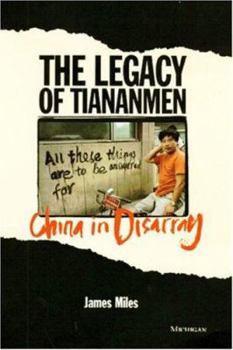
The Legacy of Tiananmen: China in Disarray


Select Format
Select Condition 
Book Overview
In The Legacy of Tiananmen, James A. R. Miles asks whether senior leader Deng Xiaoping's gamble that prosperity would bring stability to China has worked or whether, instead, the country's economic... This description may be from another edition of this product.
Format:Hardcover
Language:English
ISBN:0472107313
ISBN13:9780472107315
Release Date:June 1996
Publisher:University of Michigan Press
Length:408 Pages
Weight:1.65 lbs.
Dimensions:9.5" x 1.5" x 6.5"
Related Subjects
History Political Science Politics & Social Sciences Social Science Social SciencesCustomer Reviews
1 rating
An important corrective to excessive optimism about China.
Published by Thriftbooks.com User , 27 years ago
I spent 7 years in China, as a diplomat and a lawyer, and I recognize the China which James Miles describes. He has slogged around the grubby disaster sites which pass for towns and cities in the PRC, and has not restricted his range of interlocutors to the usual staple fare of journalists: Beijing-based dissidents, governmental officials and taxi drivers. For the clarity of its analysis, rigorously fair unsentimentality about China and eschewal of the intrusive personal heroics to which so many journalists writing about China succumb, Miles' book stands head and shoulders above most of the recent offerings by reporters who have been posted to the Middle Kingdom. What I found admirable about this book by a long-time and respected Beijing-based BBC correspondent was its contrarian approach. Miles refused to be dazzled by the glitter of rapid economic growth, choosing instead to focus on the inner brittleness of a political order beset by corruption, fissiparous regionalism, mass migration (nearly 100 million peasants have left their villages in the past decade in search of work) and structural inadaption of the political order to a quickly changing society. Although his book was published well before the Asian financial and institutional crisis which began in late 1997, Miles' analysis of China would need no updating to accomodate the devastating impact of "crony capitalism" on some of China's near neighbours (and China next??) which more superficial journalistic commentators seem not to have discovered until the crisis hit.Despite its excellence, I think the book would have benefitted from inclusion of a chapter setting out a more formal political analysis bringing in the perspectives of development, the specifities of modern Chinese political and economic history, and the Leninist state structure which survives intact despite the dismemberment of most of the socialist economic system. An overarching structure of that sort might have helped Miles (or his editors) avoid occasionally giving the impression of heaping anecdote upon anecdote, however interesting and telling those anecdotes are. This, however, is a minor reproach for what really is an excellent book.Since he predicts a more or less iminent collapse of China's political system, while coyly declining to make any guesses about when this will occur, James Miles has opened himself to criticism if this does not transpire. Such a critique would be facile and beside the point; the real contribution of the book is to take a close look at the underside of the rock.The book deserves a wide readership.
Copyright © 2026 Thriftbooks.com
Terms of Use | Privacy Policy | Do Not Sell/Share My Personal Information | Cookie Policy | Cookie Preferences | Accessibility Statement
ThriftBooks ® and the ThriftBooks ® logo are registered trademarks of Thrift Books Global, LLC
ThriftBooks ® and the ThriftBooks ® logo are registered trademarks of Thrift Books Global, LLC
