


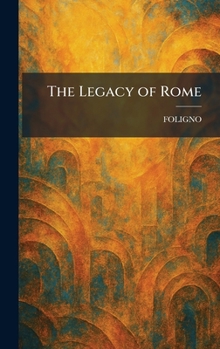
The Legacy of Rome

"The Legacy of Rome" is a comprehensive exploration of the enduring impact of Roman civilization on the Western world. This scholarly collection examines the vast contributions of Rome across various fields, including law, government, architecture, language, and literature. Rather than a mere chronological history, the work focuses on how the structures and ideas established by the Roman Empire continued to shape the development of Europe and beyond long after the fall of the city itself.
Each section delves into specific aspects of Roman life and thought, tracing their evolution and survival through the Middle Ages and into the modern era. From the intricate systems of Roman jurisprudence to the monumental feats of engineering and the lasting power of the Latin tongue, the book illustrates the foundational role Rome played in building the cultural and political framework of modern society. "The Legacy of Rome" serves as an essential resource for those seeking to understand the roots of Western heritage and the profound debt owed to the ancient Roman world.
This work has been selected by scholars as being culturally important, and is part of the knowledge base of civilization as we know it. This work was reproduced from the original artifact, and remains as true to the original work as possible. Therefore, you may see the original copyright references, library stamps (as most of these works have been housed in our most important libraries around the world), and other notations in the work.
This work is in the public domain in the United States of America, and possibly other nations. Within the United States, you may freely copy and distribute this work, as no entity (individual or corporate) has a copyright on the body of the work.
As a reproduction of a historical artifact, this work may contain missing or blurred pages, poor pictures, errant marks, etc. Scholars believe, and we concur, that this work is important enough to be preserved, reproduced, and made generally available to the public. We appreciate your support of the preservation process, and thank you for being an important part of keeping this knowledge alive and relevant.
Related Subjects
HistoryCustomer Reviews
ThriftBooks ® and the ThriftBooks ® logo are registered trademarks of Thrift Books Global, LLC
