


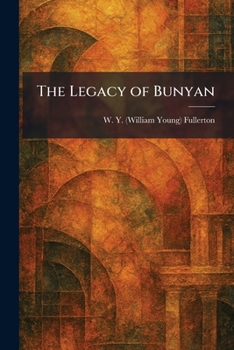
The Legacy of Bunyan

"The Legacy of Bunyan" by W. Y. Fullerton is an insightful exploration of the life, character, and enduring influence of John Bunyan, the iconic author of "The Pilgrim's Progress." Written by the noted Baptist preacher and biographer William Young Fullerton, this work provides a comprehensive look at the spiritual and literary heritage left behind by one of the most significant figures in English religious history.
The book examines the depth of Bunyan's convictions, the trials he faced during his imprisonment, and the universal appeal of his allegorical storytelling. Fullerton offers a thoughtful analysis of how Bunyan's simple yet profound prose resonated with diverse audiences, shaping the devotional lives of millions across several centuries. Rather than a mere chronological account, this work serves as an appreciation of Bunyan's lasting contribution to Christian thought and the English literary canon.
Readers will find a detailed study of the themes of pilgrimage, faith, and perseverance that defined Bunyan's most famous works. This volume is an essential resource for those interested in the history of Puritanism, the development of religious literature, and the historical impact of one of the world's most widely read authors.
This work has been selected by scholars as being culturally important, and is part of the knowledge base of civilization as we know it. This work was reproduced from the original artifact, and remains as true to the original work as possible. Therefore, you may see the original copyright references, library stamps (as most of these works have been housed in our most important libraries around the world), and other notations in the work.
This work is in the public domain in the United States of America, and possibly other nations. Within the United States, you may freely copy and distribute this work, as no entity (individual or corporate) has a copyright on the body of the work.
As a reproduction of a historical artifact, this work may contain missing or blurred pages, poor pictures, errant marks, etc. Scholars believe, and we concur, that this work is important enough to be preserved, reproduced, and made generally available to the public. We appreciate your support of the preservation process, and thank you for being an important part of keeping this knowledge alive and relevant.
Customer Reviews
ThriftBooks ® and the ThriftBooks ® logo are registered trademarks of Thrift Books Global, LLC
