


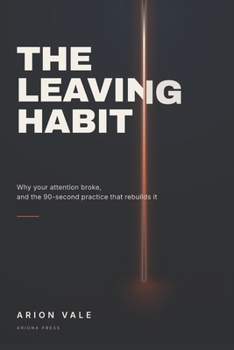
The Leaving Habit: Why Your Attention Broke, and the 90-Second Practice That Rebuilds It

At 11:04pm you open the book you have been meaning to finish since March. You read a sentence. Somewhere around the third one your hand is holding your phone - and you do not remember picking it up. Thirty-five minutes later you surface, and the sentence that arrives is the one that made you look for this book: I think something is actually wrong with me now.
Nothing is wrong with you. But something is happening that you have never once looked at.
Every time you leave a task, you pass through the same two seconds: discomfort, hand, gone. It happens between twenty and forty times an hour at your desk, and you have never witnessed a single one of them. That is why nine years of app blockers, timer cubes, thirty-day detoxes and Sunday-night resolutions have not moved the number. They were all aimed at the wrong end of the event.
The Leaving Habit is a repair manual for adults who cannot quit their phone and cannot quit their job. No cabin. No monk mode. No apps to delete. It teaches a five-move practice called the Stay Loop, which runs in the two seconds where your attention is actually decided:
Count - one working hour, one piece of paper, and the number nobody has ever shown you.Catch - stopping inside the two seconds, with your hand already on the phone.Name - the five reasons anyone leaves a task: fog, dread, itch, sting, blank. Each needs a different move, and you have been applying willpower to all five.Hold - ninety seconds, with the exact move for the ache you just named.Return - what to do in the four minutes after you lose half an hour, which decides your week more than the half hour did.Inside you will find the tally hour that makes an invisible habit countable; the reason deleting the app relapses on day five; the fog note that starts a task you have been avoiding since March; the smallest-visible-piece move for the email you have not sent in eleven days; the true sentence that ends an ego exit; the blank test that tells you when stopping is correct; a reachability script for a manager, a partner, and a nine-year-old; and a reading ladder that takes you from four pages back to a finished book.
Every chapter ends with a section on where the practice fails and what to do the day after you fail - the section most books in this category leave out. Every research claim is named, dated and checkable, including the ones that cut against the argument. The eight-second attention span you have heard about a hundred times is traced back to its source, and there is nothing there.
What you get by the last page: the ability to see the moment you leave a task, name what you were leaving, and stay ninety seconds past it - on an ordinary Tuesday, at your real desk, with your phone in the room.
Short, specific, and built for people with jobs. Start tonight with fifteen minutes, a book, and a piece of paper.
Customer Reviews
ThriftBooks ® and the ThriftBooks ® logo are registered trademarks of Thrift Books Global, LLC
